 EN

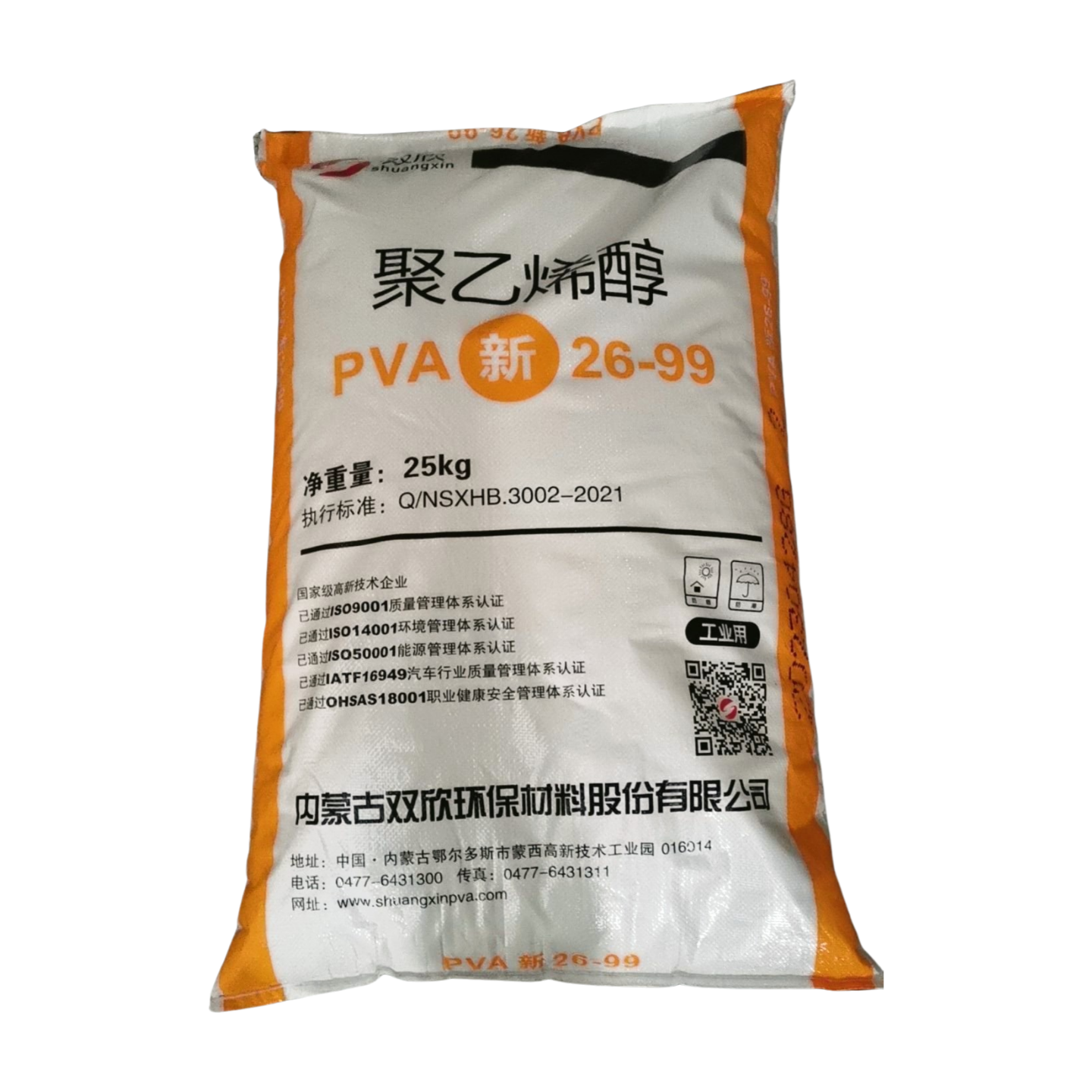
Chemical & Physical Foundations: How Hydrolysis and Molecular Weight Define PVA 2699 and PVA 1799
Degree of Hydrolysis (98–99% vs 87–89%): Impact on Water Solubility, Film Integrity, and Humidity Resistance
Polyvinyl Alcohol (PVA) grades 2699 and 1799 are distinguished primarily by their degree of hydrolysis—the extent to which acetate groups have been converted to hydroxyl groups. PVA 2699, with a hydrolysis degree of 98–99%, is nearly fully hydrolyzed. This creates a polymer chain densely packed with hydroxyl groups, promoting intense inter- and intramolecular hydrogen bonding. The result is a highly crystalline structure that resists water penetration, yielding dry films that are tough, rigid, and exceptionally humidity-resistant. However, dissolution requires elevated temperatures and extended mixing, as water must overcome these strong hydrogen bonds.
In contrast, PVA 1799—hydrolyzed to 87–89%—retains a significant fraction of residual acetate groups. These bulky side chains disrupt chain packing and crystallinity, increasing free volume and chain flexibility. Consequently, PVA 1799 dissolves rapidly at ambient or moderately warm temperatures. Its trade-off is reduced film strength and higher moisture sensitivity. For industrial bonding, PVA 2699’s high hydrolysis delivers durable, humidity-resistant adhesion on cellulose substrates, while PVA 1799’s lower hydrolysis suits applications where rapid dissolution and strong initial tack outweigh long-term environmental resistance.
Molecular Weight Contrast (145,000–186,000 g/mol vs 45,000–65,000 g/mol): Effects on Viscosity, Cohesive Strength, and Shear Stability
Molecular weight governs the rheological and mechanical behavior of PVA solutions and films. PVA 2699 falls in the high-molecular-weight range of 145,000–186,000 g/mol; PVA 1799 is low-molecular-weight at 45,000–65,000 g/mol. At identical solids content, PVA 2699’s longer chains generate significantly higher solution viscosity and greater chain entanglement density—directly enhancing cohesive strength and resistance to mechanical stress. This translates into superior shear stability: bonds maintain integrity under dynamic loads in high-speed packaging, lamination, and converting operations.
PVA 1799’s shorter chains yield low-viscosity solutions that wet fibrous surfaces quickly but form inherently weaker films. Reduced entanglement leads to lower cohesive strength and greater susceptibility to creep under sustained load. While advantageous for pumpability, fast set times, and low-application-viscosity processes, PVA 1799 cannot match PVA 2699’s performance where long-term structural integrity and resistance to shear deformation are critical.
Bonding Performance in Real-World Industrial Applications
Adhesion Strength and Peel Resistance on Cellulose-Based Substrates (Paperboard, Corrugated Board, Kraft Liner)
PVA 2699’s near-complete hydrolysis (98–99%) yields a hydroxyl-rich surface that forms robust hydrogen bonds with cellulose fibers. On kraft liner, peel adhesion exceeds 2.5 N/cm—outperforming PVA 1799 by at least 30% in TAPPI T-815 comparative testing. Its dense, crystalline film limits moisture uptake to under 12% after 24 hours at 90% RH, versus over 20% for lower-hydrolysis grades. On corrugated board and paperboard, the combination of high hydrolysis and high molecular weight (~150,000 g/mol) delivers a balanced tack-elastic response that prevents adhesive fracture during board flexing. Field trials on recycled liners show cohesive failure—tearing of paper fibers rather than delamination—within 0.5 seconds of compression, ensuring immediate handling strength on high-speed converting lines.
Open Time, Set Speed, and Thermal Stability in High-Speed Packaging Lamination and Carton Sealing
At 4–6% solids, PVA 2699’s viscosity extends open time to 5–8 seconds under ambient conditions—enabling precise applicator registration during roll-coating or extrusion. Despite its slightly longer tack phase, set speed remains competitive: a 3 mm bead on clay-coated board achieves 80% of ultimate shear strength within 1.2 seconds of nip pressure, per in-line laser speckle measurements. Crucially, PVA 2699 films retain integrity up to 120°C without charring—a key advantage in heated calender lamination. In continuous carton sealing operations, this thermal stability reduces downtime from adhesive skinning by 40% compared to plasticizer-heavy alternatives, delivering reliable bonds that resist edge lift or peel-back during downstream shrink-wrapping.
Processing Compatibility: Optimizing PVA 2699 Use in Roll Coating, Spray, and Extrusion Systems
Viscosity Behavior at 4–6% Solids: Implications for Pumpability, Atomization, and Uniform Film Formation
PVA 2699’s high molecular weight (145,000–186,000 g/mol) and near-complete hydrolysis produce viscous solutions even at low solids. At typical industrial concentrations of 4–6%, its viscosity challenges conventional pumping—requiring positive displacement pumps or heated fluid delivery for consistent flow. In spray applications, fine atomization demands air-assisted airless nozzles and controlled turbulence to minimize droplet size variation and ensure uniform coverage. For roll coating and slot-die extrusion, stable rheology is essential for defect-free film formation; operators must optimize roller nip pressure and die gap to prevent streaking or thickness variation. Pre-heating solutions to 40–50°C reduces viscosity by up to 40% without compromising bond performance—enabling reliable thin-film deposition across diverse high-speed platforms.
Strategic Adoption of PVA 2699: Cost-Benefit Analysis and Supply Chain Readiness
Evaluating PVA 2699 solely on unit price overlooks its systemic value. Though raw material costs run 8–12% higher than partially hydrolyzed alternatives, its thermal stability, minimal charring, and extended pot life reduce equipment cleaning frequency and application waste—lowering total applied cost by up to 15%, per the 2023 Adhesive and Sealant Council benchmarking study. A concise cost-value comparison illustrates the operational shift:
| Cost/Value Element | Partial-Hydrolysis PVA (Baseline) | PVA 2699 Impact |
|---|---|---|
| Raw material (per kg) | $X | $1.08–1.12X |
| Application waste | 4–7% loss from gel specks | ≤ 2% loss |
| Line downtime | 3–5 cleaning cycles/month | 1 cycle/month |
| Customer returns (bond failure) | 0.8–1.2% | ≤ 0.3% |
| Brand-equity risk | Moderate | Low |
Supply chain readiness depends on dual-sourcing from ISO-certified producers and verifying batch-to-batch consistency in viscosity and molecular weight (145,000–186,000 g/mol). Maintaining a 6- to 8-week buffer stock mitigates seasonal capacity constraints, while pre-qualifying alternate suppliers shortens lead-time risk. As global regulations tighten around VOC emissions and single-use plastics, PVA 2699’s zero-VOC profile and inherent biodegradability future-proof compliance—avoiding reformulation expenses estimated at 4–7% of annual R&D spend for packaging converters, per McKinsey’s 2024 materials survey.
FAQs
What is the main difference between PVA 2699 and PVA 1799?
The key differences lie in their degree of hydrolysis and molecular weight. PVA 2699 is nearly fully hydrolyzed (98–99%) with a high molecular weight (145,000–186,000 g/mol), making it more water-resistant and durable. PVA 1799, with lower hydrolysis (87–89%) and molecular weight (45,000–65,000 g/mol), dissolves faster but is less resistant to moisture and mechanical stress.
Which PVA grade is better for industrial bonding applications?
PVA 2699 is better suited for industrial bonding due to its high hydrolysis and molecular weight, which deliver durable and humidity-resistant adhesion. PVA 1799 is ideal for applications requiring quick dissolution and high initial tack but has lower long-term durability.
How does molecular weight influence the performance of these PVAs?
Molecular weight affects viscosity and film strength. Higher molecular weight PVA (2699) offers greater viscosity, cohesive strength, and shear stability, while lower molecular weight PVA (1799) provides faster wetting and ease of application but weaker films.
What processing adjustments are required for PVA 2699?
PVA 2699 solutions may require pre-heating to reduce viscosity, positive displacement pumps for consistent flow, and air-assisted airless nozzles for uniform atomization in spray applications.
Is PVA 2699 environmentally friendly?
Yes, PVA 2699 is biodegradable and has a zero-VOC profile, ensuring compliance with tightening global environmental regulations.
Table of Contents
- Chemical & Physical Foundations: How Hydrolysis and Molecular Weight Define PVA 2699 and PVA 1799
- Bonding Performance in Real-World Industrial Applications
- Processing Compatibility: Optimizing PVA 2699 Use in Roll Coating, Spray, and Extrusion Systems
- Strategic Adoption of PVA 2699: Cost-Benefit Analysis and Supply Chain Readiness
- FAQs