 EN

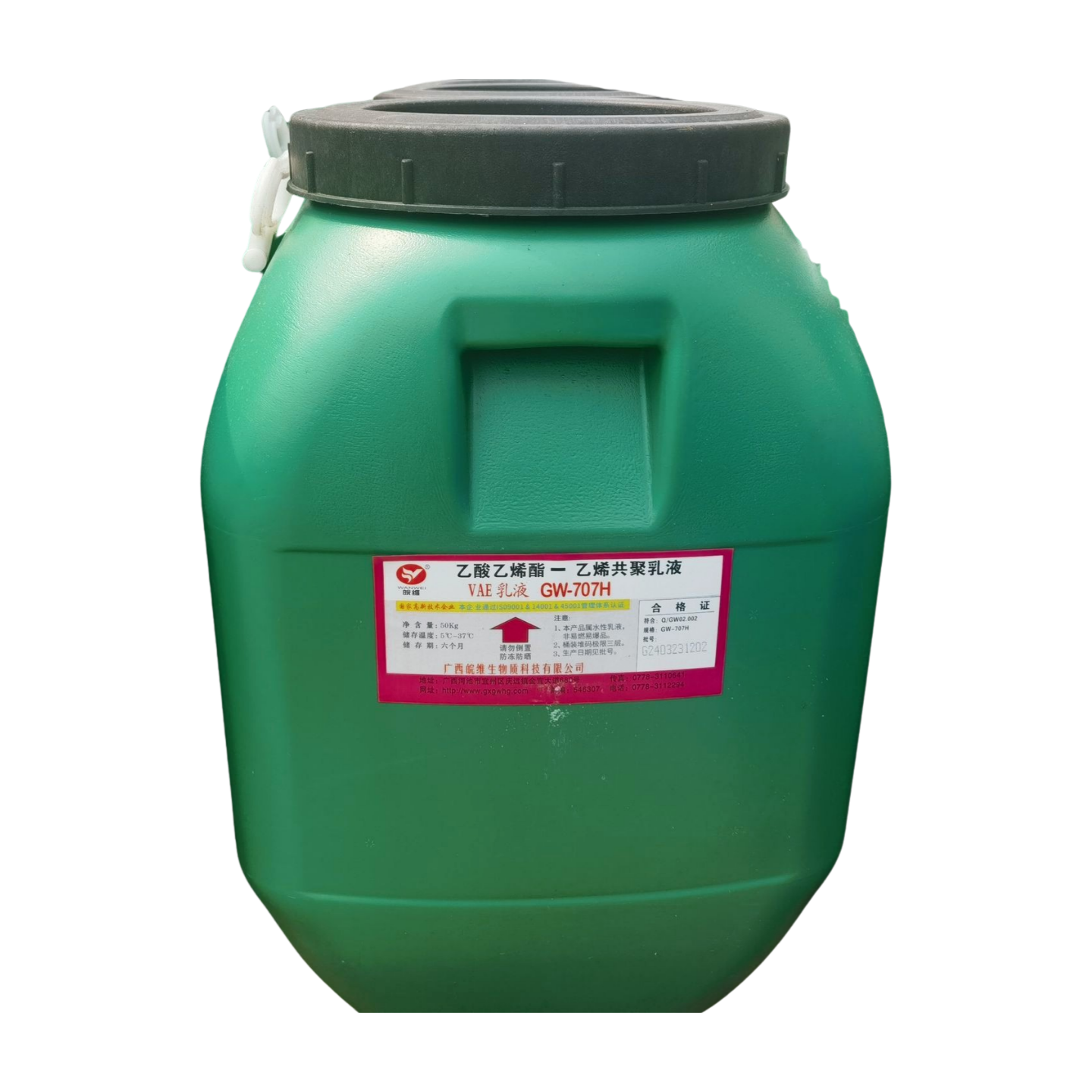
Superior Rheological Performance of GW-707H in Water-Based Formulations
GW-707H is engineered to deliver precise rheology control in water-based adhesive manufacturing, directly addressing the dual demands of application ease and bond integrity. Unlike conventional thickeners that sacrifice one property for the other, this advanced modifier uses a synergistically optimized polymer network to balance flow and stability across a wide range of processing conditions.
Shear-thinning behavior for optimal application and open-time control
GW-707H exhibits pronounced shear-thinning characteristics, meaning its viscosity drops sharply under the mechanical forces of pumping, roll coating, or spraying. At typical application shear rates of 100–1000 s⁻¹, formulations containing just 0.4 wt% of the modifier show a viscosity reduction of up to 85%, ensuring smooth, even laydown without stringing or misting. Once the shear is removed, the network rapidly rebuilds—providing high low-shear viscosity that controls wet-film sag on vertical surfaces and extends open time by 20–30% compared to cellulosic or associative thickeners. This window allows adequate substrate repositioning before initial set, a critical advantage for high-speed assembly lines. The near-instantaneous recovery also minimizes adhesive penetration into porous substrates, preserving bond-line thickness for optimal strength (Technology Reports, 2023). Because the thinning behavior is fully reversible and reproducible over multiple stress cycles, rheology remains consistent from drum to final application—reducing operator adjustments and scrap rates.
Broad pH stability (4–9) without viscosity collapse or gelation
Water-based adhesives often require pH adjustments during formulation to accommodate co-binders, preservatives, or substrate interactions—and narrow pH tolerance frequently leads to batch failures. GW-707H remains fully functional across pH 4–9, with viscosity deviation held within ±5% in accelerated stability tests at 40°C over 30 days. Its non-ionic, sterically stabilized backbone prevents the excessive swelling or hydrolysis seen in many polyacrylic acid thickeners under alkaline conditions, eliminating sudden gelation or structural collapse. In mildly acidic vinyl acetate-ethylene (VAE) or polyurethane dispersions, it avoids catalyzing unwanted hydrolysis or metallic ion cross-linking. This predictable, plateau-like viscosity response removes the need for real-time rheology correction and enables standardized processes across diverse adhesive lines—improving productivity, reducing off-spec batches, and delivering a reliable, sprayable adhesive that performs identically from day one.
GW-707H Delivers Sustainable Performance Without Compromising Bond Integrity
Enabling low-VOC, USDA BioPreferred-compliant adhesive systems
GW-707H supports the development of water-based adhesives that meet stringent low-VOC standards and qualify for the U.S. Department of Agriculture’s BioPreferred program. Its associative thickener mechanism interacts with polar functional groups on bio-based latexes and natural tackifiers, reinforcing the colloidal network without volatile coalescents. At typical dosages of 0.3–0.6 wt%, formulations consistently achieve VOC levels below 40 g/L—well under California’s SCAQMD Rule 1168 limit of 50 g/L for construction adhesives (effective 2022). Its broad pH stability and strong suspensive properties prevent pigment and filler settling, enabling high-solids, low-VOC systems that retain smooth, drip-free application. By eliminating solvent-based carriers, GW-707H helps manufacturers meet LEED and USDA BioPreferred sustainability certifications—expanding market access while preserving open time and initial tack essential for efficient assembly. Its shear-thinning behavior further reduces stringing and clean-up costs, shrinking environmental impact without sacrificing in-plant productivity.
Maintaining ≥92% tensile adhesion after 7-day humidity aging (ASTM D1002)
Bond durability under humid conditions is critical for water-based adhesives used in packaging, woodworking, and construction. Lap shear testing per ASTM D1002 shows that joints bonded with a GW-707H-modified acrylic adhesive retain more than 92% of their initial tensile adhesion after 7 days at 95% RH and 38°C. This moisture resistance arises from the modifier’s ability to promote uniform film coalescence and robust interfacial adhesion—minimizing water ingress at the bond line. Unlike conventional cellulosic thickeners, which can weaken the polymer network, GW-707H reinforces the adhesive matrix, preserving cohesive strength under hydrolytic stress. As a result, manufacturers achieve long-term bond integrity without post-cure crosslinkers or silane adhesion promoters—streamlining production and lowering raw material costs. This performance meets demanding requirements for flexible packaging laminating adhesives and structural wood bonding, confirming GW-707H’s cross-industry versatility.
Cost-Effective Scalability of GW-707H in Industrial Production
Low-dosage efficiency (0.3–0.6 wt%) reduces raw material and logistics costs
GW-707H delivers exceptional thickening power: industry formulation studies confirm it achieves equivalent or superior rheological control at just 0.3–0.6 wt%, compared to the 1–2 wt% typically required by standard rheology modifiers—a raw material reduction of up to 70%. This low-dosage efficiency directly lowers per-unit formulation cost and creates compounding savings across the supply chain. Reduced weight and volume per finished unit shrink warehousing footprint and shipping expenses; bulk-purchase analysis (2023) estimates inbound freight cost reductions of ~12% annually simply by decreasing the physical mass of procured materials needed for the same output. Operationally, lower-viscosity pre-mix stages and faster incorporation times shorten batch cycle times and cut energy use associated with high-shear mixing. This leaner manufacturing process—enabled by GW-707H’s potent dosage profile—allows producers to scale output rapidly without proportionally increasing operational overhead or complexity.
FAQ
What is GW-707H primarily designed for?
GW-707H is engineered to optimize rheology control in water-based adhesive manufacturing, improving application and bond performance without compromising on quality.
What are the key benefits of GW-707H?
GW-707H provides shear-thinning properties for smooth application, broad pH stability, low-VOC compliance, moisture resistance for long-term bond durability, and cost-effective scalability in industrial production processes.
What is the recommended dosage for GW-707H?
Typically, GW-707H is effective at a dosage of 0.3–0.6 wt%, significantly reducing raw material usage compared to standard rheology modifiers.
What pH range is optimal for GW-707H performance?
GW-707H performs optimally across a broad pH range of 4–9, maintaining viscosity stability under various conditions.
Does GW-707H comply with sustainability standards?
Yes, GW-707H supports low-VOC formulations and qualifies for the USDA BioPreferred program, meeting stringent sustainability requirements.