 EN

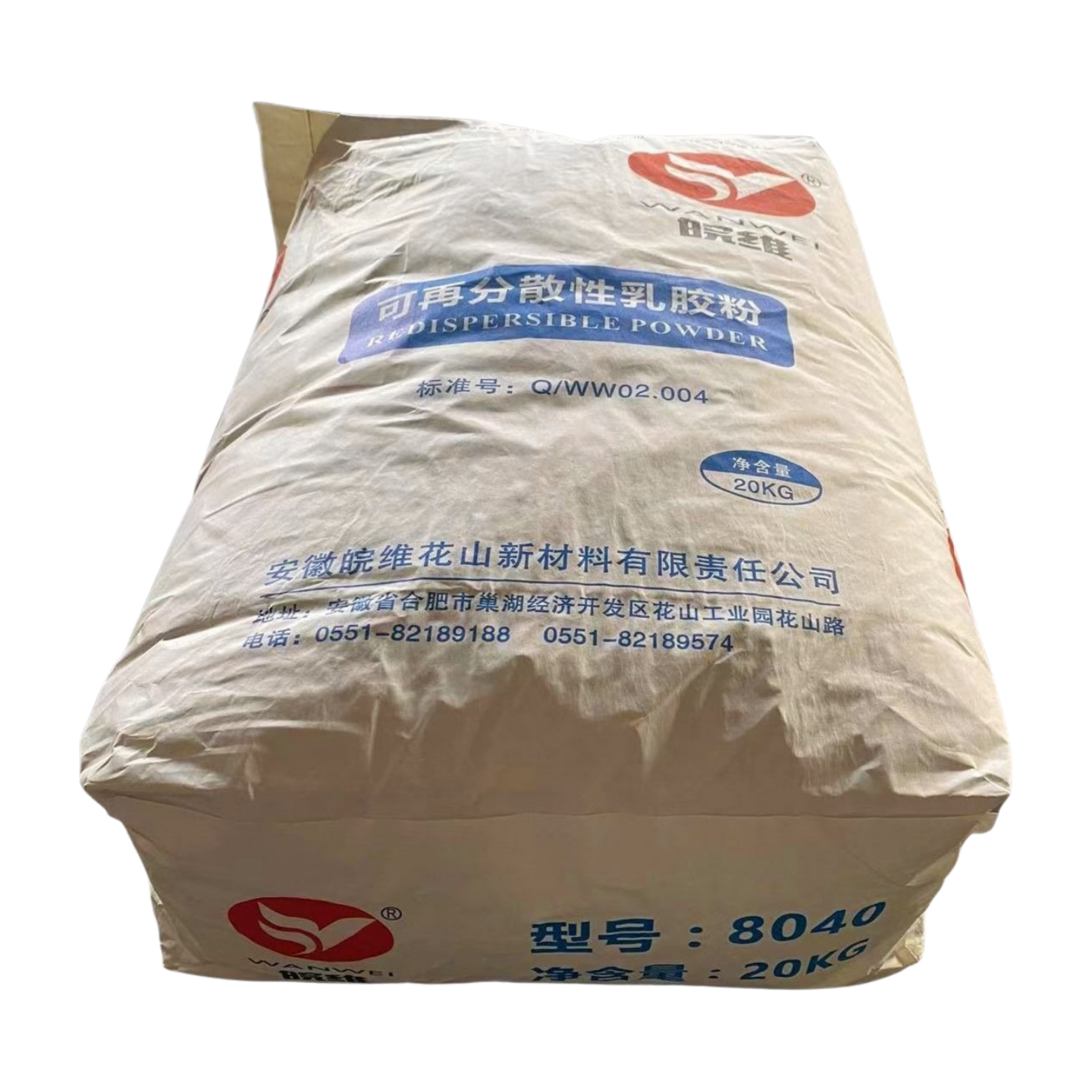
Understanding RDP 8040’s Core Performance Profile for Dry Mortar Applications
Glass transition temperature (Tg) and its direct impact on flexibility, adhesion, and crack-bridging in skim coats and repair mortars
The glass transition temperature (Tg) of a polymer marks the threshold at which it shifts from rigid to flexible. RDP 8040’s Tg is engineered near 0°C (Wacker TB‑8040-2023), a deliberate calibration that directly governs performance in dry mortar systems. Below Tg, the polymer behaves like a brittle glass—limiting deformation; above Tg, it becomes ductile and capable of absorbing mechanical stress. In skim coats and repair mortars, this transition enables effective crack-bridging: the continuous polymer film stretches to accommodate substrate micro-movements caused by thermal expansion or settlement, thereby inhibiting crack propagation. Adhesion improves as the flexible film penetrates substrate pores and forms a robust mechanical anchor—maintaining high peel strength even under dynamic loading. Field data show a 3% RDP 8040 dosage increases crack-bridging capacity by 50% compared to unmodified mortar. For repair mortars, the film fills interfacial gaps and delivers tensile bond strengths routinely exceeding 1.5 N/mm² on concrete. A Tg that is too low would compromise load-bearing integrity at ambient temperatures; RDP 8040’s balanced value thus delivers reliable flexibility, adhesion, and long-term crack resistance in dynamic applications.
Why RDP 8040’s VAE-based copolymer architecture delivers balanced toughness and cement compatibility vs. acrylic or tripolymer alternatives
RDP 8040 employs a vinyl acetate–ethylene (VAE) copolymer backbone that synergizes vinyl acetate’s high cohesive strength with ethylene’s internal plasticization. Unlike many acrylic powders—which can retard early cement hydration and weaken interfacial zones—the VAE structure disperses as ultrafine particles, forming a uniform, coalesced polymer film during drying that enhances both tensile strength and elongation. While styrene-acrylic tripolymers offer high initial stiffness, they often lose elastomeric recovery after repeated freeze-thaw cycling; VAE’s ethylene segments retain resilience even after 50 cycles. Critically, VAE exhibits superior chemical compatibility with cement’s alkaline environment: its film resists saponification and degradation at high pH, avoiding the adhesion loss seen in some polyvinyl acetate formulations. Comparative testing confirms VAE-based RDP delivers a 20% gain in flexural strength over acrylics at equal dosage (Celotech analysis). Additionally, ethylene moieties moderate water uptake—reducing the risk of delayed ettringite formation associated with pure acrylic-modified mortars. This architecture delivers the balanced toughness, alkali stability, and long-term durability required for demanding dry mortar applications.
Optimizing RDP 8040 Dosage Across Dry Mortar Systems
Data-driven dosage guidelines: 2–4% RDP 8040 for tile adhesives, repair mortars, and self-leveling underlayments (per Wacker TB-8040-2023)
According to Wacker’s 2023 technical bulletin TB‑8040‑2023, a 2–4% dosage of RDP 8040 by cement weight is optimal across tile adhesives, repair mortars, and self-leveling underlayments. In ceramic tile adhesives, 2–3% typically achieves tensile adhesion strength >0.5 MPa after water immersion—meeting EN 12004 C2 classification—and extends open time by up to 15 minutes versus unmodified mixes. For polymer-modified repair mortars, 3–4% significantly enhances crack-bridging capacity (often exceeding 0.3 mm at 28 days) and substrate bond strength while delivering thixotropic consistency ideal for vertical applications. Self-leveling underlayments dosed at 2–4% show a 30% increase in flexural strength and maintain a smooth, defect-free surface post-cure. Within this range, the VAE copolymer fully coalesces into a continuous film that interpenetrates cement hydrates—boosting flexibility and water resistance without introducing excessive air voids. These values serve as a robust starting point; formulators should fine-tune based on filler composition, workability targets, and regional climate conditions to sustain cost-performance balance.
Recognizing diminishing returns—loss of cost-efficiency and potential workability trade-offs above 4% RDP 8040
Exceeding the 4% dosage threshold rarely yields proportional performance gains. Adhesion and waterproofing improvements plateau, while raw material cost per unit of added strength rises sharply. Excess polymer can entrain air, softening the matrix and reducing early compressive strength—potentially compromising structural integrity in load-bearing applications. Workability also declines: elevated viscosity impedes mixing, troweling, and pumping. In self-leveling compounds, over 4% may delay setting and induce segregation, degrading surface finish. Consequently, pushing beyond this ceiling often undermines both economics and practical application. Rather than increasing RDP dosage, formulators should leverage synergistic additives—such as optimized cellulose ethers for open time or superplasticizers for flow—to meet performance goals without sacrificing efficiency.
Achieving Formulation Synergy: RDP 8040 with Key Co-Additives
Balancing RDP 8040 with cellulose ethers and hydrophobic agents unlocks dry mortar performance far beyond what the polymer alone delivers. Precision in co-additive ratios is essential to harmonize open time, film formation, and moisture resistance within tile adhesives, repair mortars, and self-leveling compounds.
Cellulose ether interactions: managing air entrainment, open time extension, and polymer film continuity
Cellulose ethers (e.g., HPMC) extend open time and improve water retention—but often introduce excessive air voids that weaken the hardened matrix. RDP 8040 mitigates this drawback: its VAE particles redisperse and coalesce during drying to form a continuous, crack-bridging film that encapsulates and fills cellulose ether domains. This interaction reduces air entrainment while preserving workability. Industry trials confirm that pairing 3% RDP 8040 with 0.3% HPMC extends open time by up to 20% without compromising film continuity—ensuring uniform adhesion, sag resistance, and mechanical integrity.
Complementary roles of redispersible polymer powder (RDP 8040) and hydrophobic agents in enhancing water resistance
RDP 8040 enhances flexibility, adhesion, and crack-bridging but does not inherently reduce capillary water absorption. Hydrophobic agents—such as silanes or metal stearates—function by lining capillary pores and lowering surface energy. When combined, RDP 8040’s polymer network immobilizes the hydrophobic phase, preventing leaching during curing or service life. The result is up to 50% lower water absorption compared to RDP 8040 alone—without sacrificing mechanical strength. This synergy enables durable, low-maintenance mortars for wet-area tile installations, external renders, and waterproof repair systems.
Validating Customized RDP 8040 Formulations Through Standardized Testing
Before scaling up a dry mortar formulation containing RDP 8040, rigorous laboratory validation ensures the tailored polymer content delivers the intended balance of workability, adhesion, and durability. Standardized tests—including tensile adhesion strength per EN 12004 for tile adhesives and pull-off resistance on concrete—provide quantitative benchmarks. For repair mortars, crack-bridging performance is evaluated via cyclic flexural testing (EN 14891), while water resistance is assessed through capillary absorption and hydrophobicity indices. A well-designed test matrix compares the customized mix against both a non-polymer-modified control and an equivalent formulation using a standard-grade polymer, confirming statistically significant improvements attributable to RDP 8040. In self-leveling underlayments, flow measurements and setting time analysis complement mechanical testing to capture any workability trade-offs. By anchoring lab results to site-specific requirements—such as high early strength for fast-track tiling or extended open time in hot climates—engineers finalize RDP 8040 dosage with confidence, minimizing field adjustments and post-installation callbacks.
FAQ
What is the significance of the glass transition temperature (Tg) in RDP 8040?
The glass transition temperature (Tg) determines the temperature at which the polymer becomes flexible, enabling crack-bridging, better adhesion, and accommodation for substrate micro-movements in dry mortar applications.
Why is VAE-based RDP 8040 preferred over acrylic or tripolymer alternatives?
RDP 8040’s VAE copolymer structure provides better compatibility with cement, improved toughness, and resistance to saponification, outperforming acrylic and tripolymers in durability and flexibility.
What is the optimal dosage range for RDP 8040 in dry mortar systems?
The optimal dosage is typically 2–4% by cement weight, depending on the application, such as tile adhesives, repair mortars, or self-leveling underlayments.
What are the trade-offs of exceeding the 4% dosage threshold for RDP 8040?
Excessive dosages can lead to diminished cost-efficiency, reduction in compressive strength, decreased workability, air entrainment, delayed setting, and poorer surface finish.
How can RDP 8040 be effectively combined with other additives?
RDP 8040 works synergistically with cellulose ethers and hydrophobic agents to enhance open time, film continuity, crack-bridging, and water resistance while maintaining workability and mechanical integrity.
What tests validate the performance of RDP 8040-modified mortars?
Standardized tests such as tensile adhesion strength (EN 12004), pull-off resistance, cyclic flexural testing (EN 14891), and water resistance evaluations are used to validate formulations.
Table of Contents
- Understanding RDP 8040’s Core Performance Profile for Dry Mortar Applications
- Optimizing RDP 8040 Dosage Across Dry Mortar Systems
- Achieving Formulation Synergy: RDP 8040 with Key Co-Additives
- Validating Customized RDP 8040 Formulations Through Standardized Testing
-
FAQ
- What is the significance of the glass transition temperature (Tg) in RDP 8040?
- Why is VAE-based RDP 8040 preferred over acrylic or tripolymer alternatives?
- What is the optimal dosage range for RDP 8040 in dry mortar systems?
- What are the trade-offs of exceeding the 4% dosage threshold for RDP 8040?
- How can RDP 8040 be effectively combined with other additives?
- What tests validate the performance of RDP 8040-modified mortars?