 EN
EN

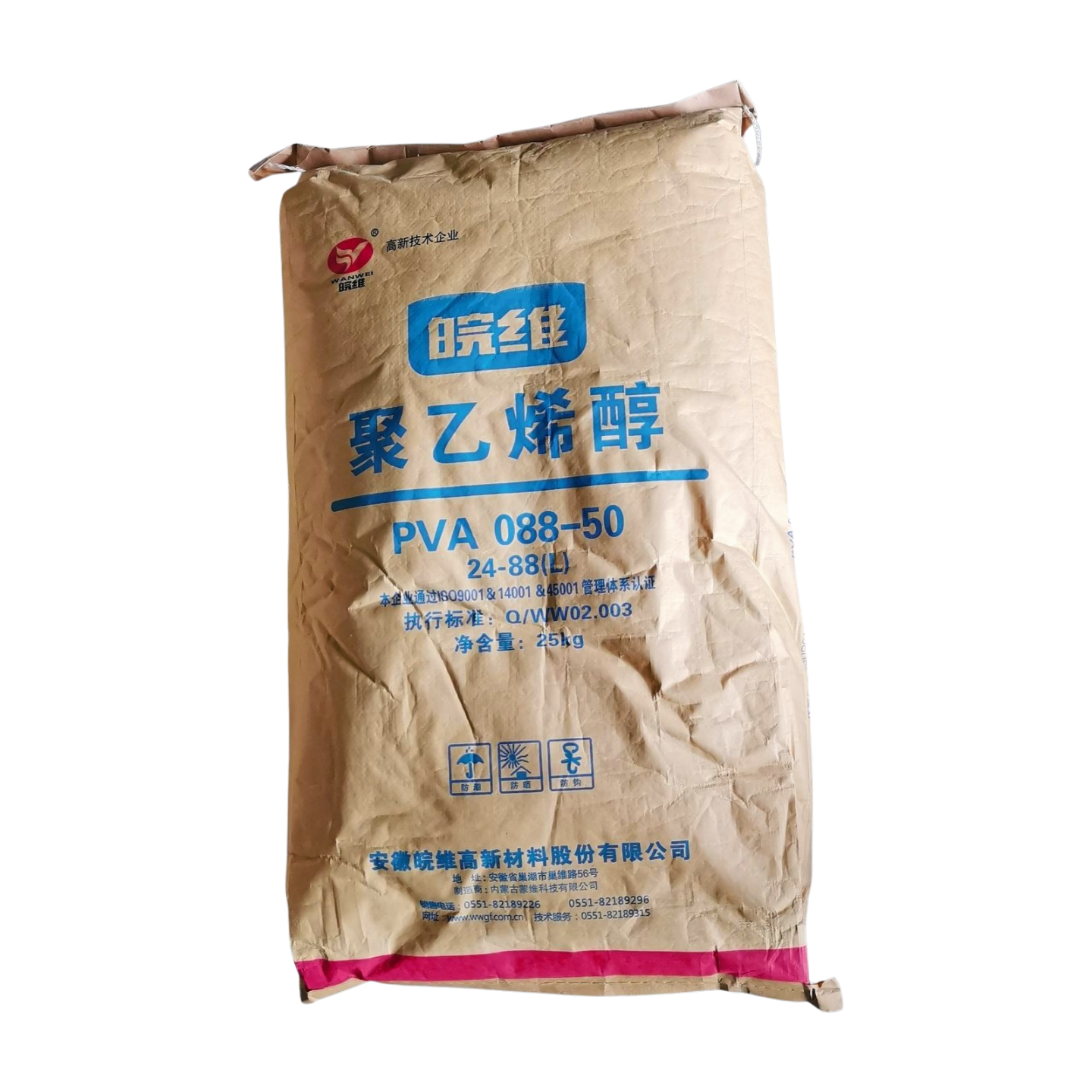
Superior Film Formation and Structural Integrity
How PVA 2488’s 88% Hydrolysis Enables Uniform, Transparent, and Cohesive Films
PVA 2488—a partially hydrolyzed polyvinyl alcohol with an 88% degree of hydrolysis—strikes an optimal balance between residual acetate groups and hydrophilic hydroxyl functionality. This molecular architecture enables rapid water solubility while supporting the formation of uniform, transparent, and mechanically robust films upon drying. Its high molecular weight promotes strong intermolecular hydrogen bonding and chain entanglement, suppressing crystallinity (which enhances optical clarity) and delivering exceptional cohesion. During casting, polymer chains align smoothly, yielding defect-free surfaces ideal for coatings or standalone barrier layers. The resulting films exhibit high tensile strength and resistance to pinhole formation—key attributes for packaging where visual appeal and uninterrupted barrier performance are essential.
Case Study: PVA 2488-Coated Paperboard for Shelf-Stable Dry Food Packaging
A leading paperboard converter applied a thin PVA 2488 coating to unbleached kraft board using gravure printing, sealing surface pores without compromising the substrate’s natural appearance. In accelerated shelf-life testing at 38°C and 50% RH, coated cartons maintained oxygen levels below 0.1% for 12 months—effectively preventing lipid oxidation in oatmeal and powdered milk. Folding endurance improved by 40%, significantly reducing cracking along score lines versus uncoated board. Crucially, the coating’s water solubility enabled full repulpability: it adhered strongly enough to withstand transport and consumer handling, yet disintegrated rapidly in standard hydropulpers. This real-world application demonstrates how PVA 2488 transforms a low-cost, renewable fiber substrate into a high-performance, circular packaging solution.
Controlled Water Solubility for Functional Single-Use Applications
Temperature- and pH-Dependent Dissolution of PVA 2488
PVA 2488’s dissolution kinetics are precisely tunable due to its 88% hydrolysis level—retaining just enough acetate groups to modulate hydrophilicity. At 20°C, films dissolve within seconds; at 5°C, dissolution slows to several minutes as hydrogen bonding with water weakens. Alkaline conditions (pH 9–11) accelerate dissolution through base-catalyzed acetate hydrolysis, while acidic environments (pH 3–5) suppress it via protonation of hydroxyl groups, reducing chain mobility. These responsive characteristics allow formulators to engineer predictable release profiles—whether for cold-water detergent pods or agrochemical sachets requiring delayed activation in soil moisture.
Cold-Water-Soluble Detergent Pods and Agrochemical Sachets Enabled by PVA 2488
PVA 2488 serves as the primary film-forming polymer in next-generation single-dose detergent pods and pre-measured agrochemical sachets. Its ability to fully dissolve even at 10°C ensures complete, residue-free release of surfactants and enzymes in laundry applications. In agriculture, the film functions as a protective, sacrificial barrier that dissolves on contact with moisture—eliminating direct handler exposure to concentrated pesticides or fertilizers. This approach improves dosing accuracy and reduces plastic waste compared to rigid containers or multi-layer laminates. As confirmed by OECD 301B testing, PVA 2488 is readily biodegradable in municipal wastewater treatment systems—supporting sustainability commitments across consumer goods and agribusiness sectors.
Optimized Barrier Performance: High Oxygen Resistance with Managed Moisture Sensitivity
Oxygen Barrier Efficacy vs. Moisture Vapor Transmission Trade-offs in PVA 2488
PVA 2488 delivers outstanding oxygen barrier performance under dry conditions—oxygen transmission rates (OTR) typically fall below 0.02 cc/m²/day at low relative humidity, per industry-standard ASTM D3985 testing. However, its hydrophilic nature causes moisture absorption as ambient humidity rises, swelling the film and disrupting hydrogen bonds. The 88% hydrolysis introduces controlled crystallinity disruption, enhancing flexibility but also increasing water vapor transmission rate (WVTR) to 0.02–0.05 g/m²/day at moderate humidity. This results in a well-documented trade-off: superior oxygen blocking when dry, but sharply reduced efficacy above ~60% RH—a behavior shared with other bio-based barriers like cellulose derivatives.
Mitigating Humidity-Driven Barrier Loss Through Blending and Coating Strategies
To stabilize PVA 2488’s oxygen barrier in humid environments, three proven strategies are employed. First, blending with hydrophobic polymers—including polylactic acid (PLA) or ethylene-vinyl alcohol (EVOH)—lowers overall moisture affinity while preserving core barrier function. Second, chemical crosslinking with agents such as glyoxal or glutaraldehyde restricts chain mobility and swelling, maintaining structural integrity. Third—and most effective—applying a thin secondary coating (e.g., plant-derived wax, lipid emulsion, or polyvinylidene chloride) creates a moisture-resistant outer layer that shields the underlying PVA matrix. This biomimetic, layered design mirrors natural edible films and allows converters to sustain OTR below 0.1 cc/m²/day even at 75% RH, extending applicability to packaged foods and humidity-sensitive industrial products.
Mechanical Reinforcement and Adhesive Compatibility in Multi-Layer Systems
Tensile Strength (55–65 MPa) and Elongation (150–200%) Enhancing Packaging Durability
PVA 2488 films combine high tensile strength (55–65 MPa) with exceptional elongation (150–200%), offering a rare synergy of rigidity and ductility. This profile enables the material to absorb mechanical stress during filling, distribution, and retail handling without cracking or tearing. Its high stretch capacity mitigates sudden punctures, while tensile resilience resists deformation under load. In multi-layer laminates, PVA 2488 acts as a structural reinforcement layer—boosting puncture resistance, edge durability, and laminate integrity. Consistent mechanical behavior also supports reliable interfacial adhesion, minimizing delamination risk under dynamic stress. By preserving film continuity through repeated flexing, PVA 2488 extends packaging service life—enabling lightweight designs without sacrificing product protection across complex supply chains.
FAQ
What is PVA 2488?
PVA 2488 is a partially hydrolyzed polyvinyl alcohol with an 88% degree of hydrolysis. It is designed for applications requiring water solubility, high barrier performance, and mechanical durability.
How does PVA 2488 enable sustainable single-use applications?
PVA 2488 offers temperature- and pH-dependent dissolution properties, making it ideal for cold-water-soluble detergent pods and agrochemical sachets. It helps replace rigid plastic containers, reducing plastic waste, and is biodegradable in wastewater systems.
What are the moisture and oxygen barrier properties of PVA 2488?
PVA 2488 provides excellent oxygen barrier performance in dry conditions but shows higher moisture vapor transmission as humidity levels rise. Blending and coating strategies can mitigate this trade-off.
Can PVA 2488-coated materials be recycled?
Yes, materials coated with PVA 2488 are repulpable and recyclable, as the coating disperses easily in standard hydropulping systems, enabling circular packaging solutions.