 EN
EN

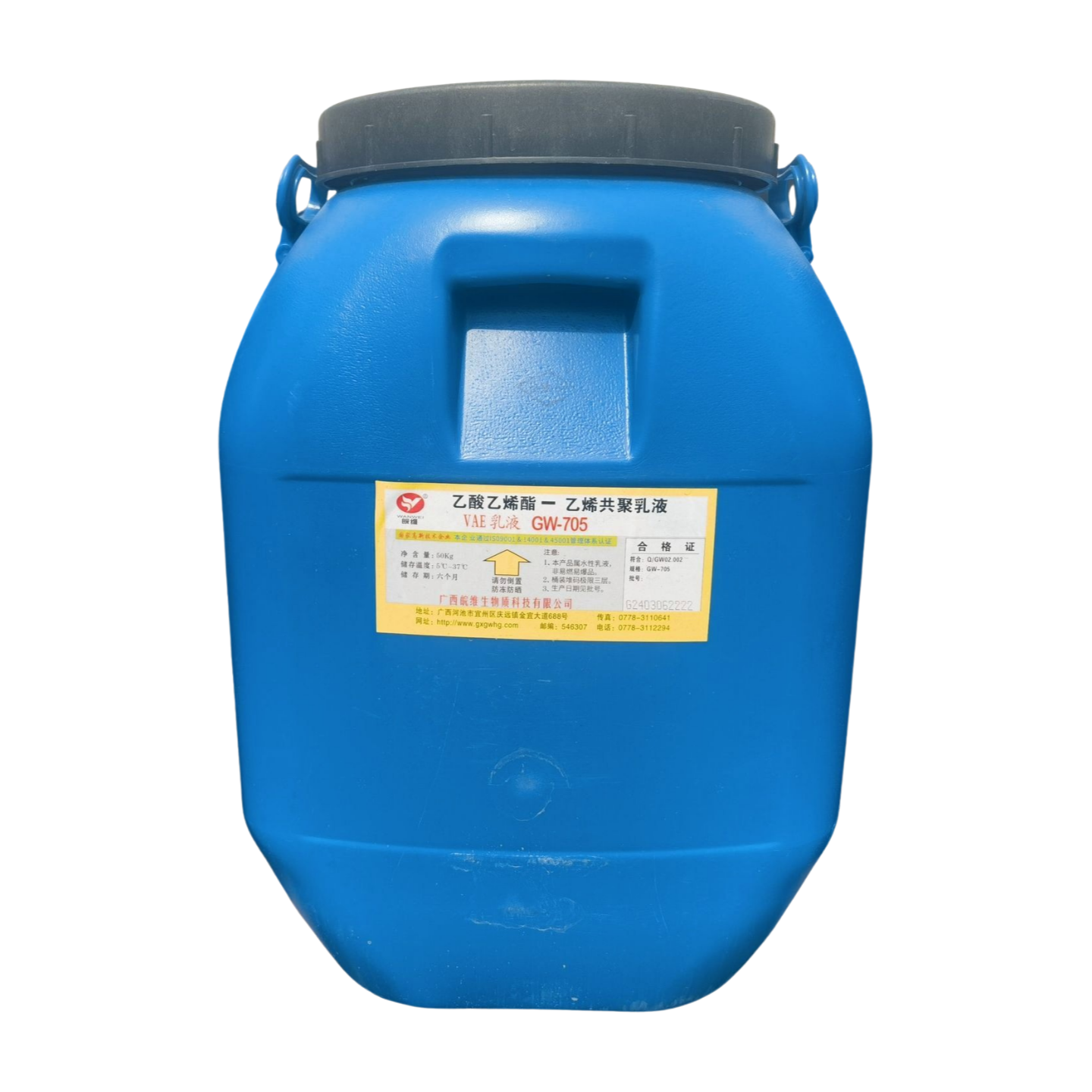
How VAE Emulsion Accelerates Drying: Mechanism and Measured Performance
VAE particle morphology and optimized water diffusion pathways
The accelerated drying of VAE (Vinyl Acetate-Ethylene) emulsion stems from its distinctive core-shell particle morphology, which establishes more efficient water diffusion pathways than conventional acrylic dispersions. During film formation, the hydrophilic shell of VAE particles supports the development of an ordered, continuous network of water channels—preventing the premature formation of a dense, impermeable surface skin that commonly traps moisture in harder acrylic systems. Crucially, ethylene acts as a permanent internal plasticizer, lowering the polymer’s glass transition temperature (Tg) and enhancing particle deformability. This allows earlier, more complete coalescence at ambient temperatures, yielding a film with reduced capillary pressure and greater permeability. As a result, water escapes not just from the surface but rapidly from deeper layers through an interconnected, low-resistance matrix—significantly accelerating overall moisture transport.
Empirical drying advantage: VAE emulsion vs. acrylics (20–40% faster evaporation at 25°C, 50% RH)
Controlled testing at 25°C and 50% relative humidity confirms VAE emulsions deliver a consistent 20–40% faster evaporation rate than standard acrylic homopolymers and styrene-acrylics. This advantage arises directly from VAE’s lower minimum film formation temperature (MFFT) and inherent flexibility, enabling rapid coalescence before full water loss—a key departure from diffusion-limited acrylic drying. The comparative performance is summarized below:
| Property | VAE Emulsion Coating | Acrylic Emulsion Coating |
|---|---|---|
| Relative Evaporation Rate | 20–40% faster baseline | Baseline |
| Film Formation Mechanism | Coalescence-driven, permeable matrix | Diffusion-limited, denser skin |
| Water Retention Tendency | Lower | Higher |
This faster water release delivers tangible industrial benefits: reduced blocking risk in stacked printed substrates, shorter set-to-touch and through-dry times, and higher line speeds without sacrificing film integrity. Importantly, the same morphological features supporting rapid drying also enhance shear stability—minimizing mist generation during high-speed application. Faster full cure further reduces energy demand when forced drying is used, improving throughput and sustainability.
Optimizing VAE Emulsion Content for Maximum Drying Speed Without Compromising Film Integrity
Critical threshold: ≥45 wt% VAE solids for coalescence-driven drying acceleration
Drying acceleration in VAE-based coatings shifts from simple evaporation to coalescence-driven kinetics only when VAE solids reach a critical concentration—typically ≥45 wt%. Below this threshold, particles remain too dispersed for efficient contact and fusion; water removal remains governed by slow capillary compaction. At 45–50 wt% binder solids, however, the higher particle density enables earlier deformation, interlocking, and pathway formation—creating a positive feedback loop where film formation actively expels water. Testing under standard conditions (25°C, 50% RH) shows tack-free time reductions of up to 30% compared to 35 wt% formulations—demonstrating how particle proximity unlocks kinetic advantages beyond mere composition.
Trade-off limits: Declining pencil hardness and MEK resistance above 55 wt% VAE emulsion
Pushing VAE content beyond 55 wt% introduces diminishing returns—and measurable trade-offs in film integrity. Excess binder density can hinder full coalescence and promote retention of hydrophilic components like polyvinyl alcohol (PVOH), the common protective colloid in VAE emulsions. Empirical data show pencil hardness dropping from HB to 2B between 50 and 60 wt% VAE solids, reflecting increased film softness. Concurrently, MEK double-rub resistance declines by over 40%, indicating compromised crosslink density and barrier function. These effects stem from continuous PVOH-rich pathways that reduce solvent resistance and long-term durability—making such high-load formulations unsuitable for demanding applications requiring mechanical or chemical robustness.
Boosting VAE Emulsion Efficiency with Smart Additives and Co-solvents
Co-solvents (e.g., n-propanol, EGBE) that lower MFFT and accelerate VAE emulsion coalescence
Co-solvents such as n-propanol and ethylene glycol butyl ether (EGBE) enhance VAE emulsion performance by temporarily plasticizing particles and lowering MFFT—enabling full coalescence at ambient temperatures. Adding 3 wt% n-propanol, for example, reduces MFFT by 8–10°C, cutting tack-free time from 18 to 12 minutes at 25°C and 50% RH—a 30% improvement. EGBE offers additional benefits: its balanced hydrophilic-lipophilic character improves wetting and interfacial adhesion, supporting uniform film formation on high-speed lines. Critically, both co-solvents fully volatilize during drying, leaving no residual plasticizer to compromise final film hardness or chemical resistance. The result is faster drying without sacrificing the flexibility and adhesion advantages inherent to VAE chemistry.
Low-VOC drying accelerators (modified siloxanes, volatile amines) enhancing interfacial water desorption
Modified siloxane surfactants and volatile amines—such as ammonia—serve as effective low-VOC drying accelerators by targeting interfacial water dynamics. Siloxanes dramatically reduce surface tension at the film-air interface, promoting rapid water release without foam generation. Volatile amines neutralize acidic groups on the polymer backbone, reducing hydrogen bonding with water and accelerating its desorption. In commercial trials, 0.5% modified siloxane reduced drying time by 18% at 25°C and 50% RH while maintaining VOC compliance (<50 g/L). Used synergistically with VAE’s intrinsic coalescence efficiency, these additives boost throughput without compromising environmental or regulatory standards.
Leveraging Temperature–Film Formation Synergy in VAE Emulsion-Based Coatings
VAE emulsions uniquely combine a low intrinsic Tg (0–10 °C) and MFFT (<5 °C), allowing them to form continuous films at ambient temperatures—unlike acrylic or styrene-acrylic binders that rely heavily on coalescing solvents. This enables powerful temperature–film formation synergy: raising substrate temperature from 25 °C to just 35–40 °C significantly intensifies Brownian motion, accelerating particle interdiffusion and entanglement before water evaporation completes. As a result, VAE systems achieve 30–50% faster water evaporation and film formation than acrylics under identical environmental conditions. Because less thermal energy is needed to mobilize rigid particles, heat input is directed efficiently toward water removal—yielding faster through-dry, lower blocking risk, and improved early water resistance—all while maintaining low VOC profiles. In practice, optimizing flash-off zone temperatures or fine-tuning oven profiles unlocks this synergy, reducing cycle times and energy consumption without compromising film integrity.
FAQ
What is the role of ethylene in VAE emulsions?
Ethylene acts as a permanent internal plasticizer, lowering the glass transition temperature (Tg) of the polymer and enhancing particle deformability. This allows earlier and more complete coalescence at ambient temperatures.
How does VAE emulsion drying compare to acrylic emulsion drying?
VAE emulsions deliver 20–40% faster evaporation compared to acrylics, primarily due to their lower MFFT and coalescence-driven drying mechanism that enables rapid water transport from deeper layers.
Why is it necessary to maintain VAE solids at ≥45 wt%?
Maintaining VAE solids at ≥45 wt% is crucial for achieving coalescence-driven drying acceleration. Below this concentration, drying remains slower as particles cannot efficiently contact and fuse.
What are the limitations of using higher VAE content beyond 55 wt%?
Excess VAE content beyond 55 wt% leads to diminished film integrity, including lower pencil hardness and reduced solvent resistance, making it unsuitable for applications demanding high durability.
How do co-solvents improve VAE emulsion drying?
Co-solvents like n-propanol and ethylene glycol butyl ether (EGBE) reduce minimum film formation temperature (MFFT) and enhance film uniformity, leading to faster and more efficient drying at ambient temperatures.
Table of Contents
- How VAE Emulsion Accelerates Drying: Mechanism and Measured Performance
- Optimizing VAE Emulsion Content for Maximum Drying Speed Without Compromising Film Integrity
- Boosting VAE Emulsion Efficiency with Smart Additives and Co-solvents
- Leveraging Temperature–Film Formation Synergy in VAE Emulsion-Based Coatings
- FAQ