 EN
EN

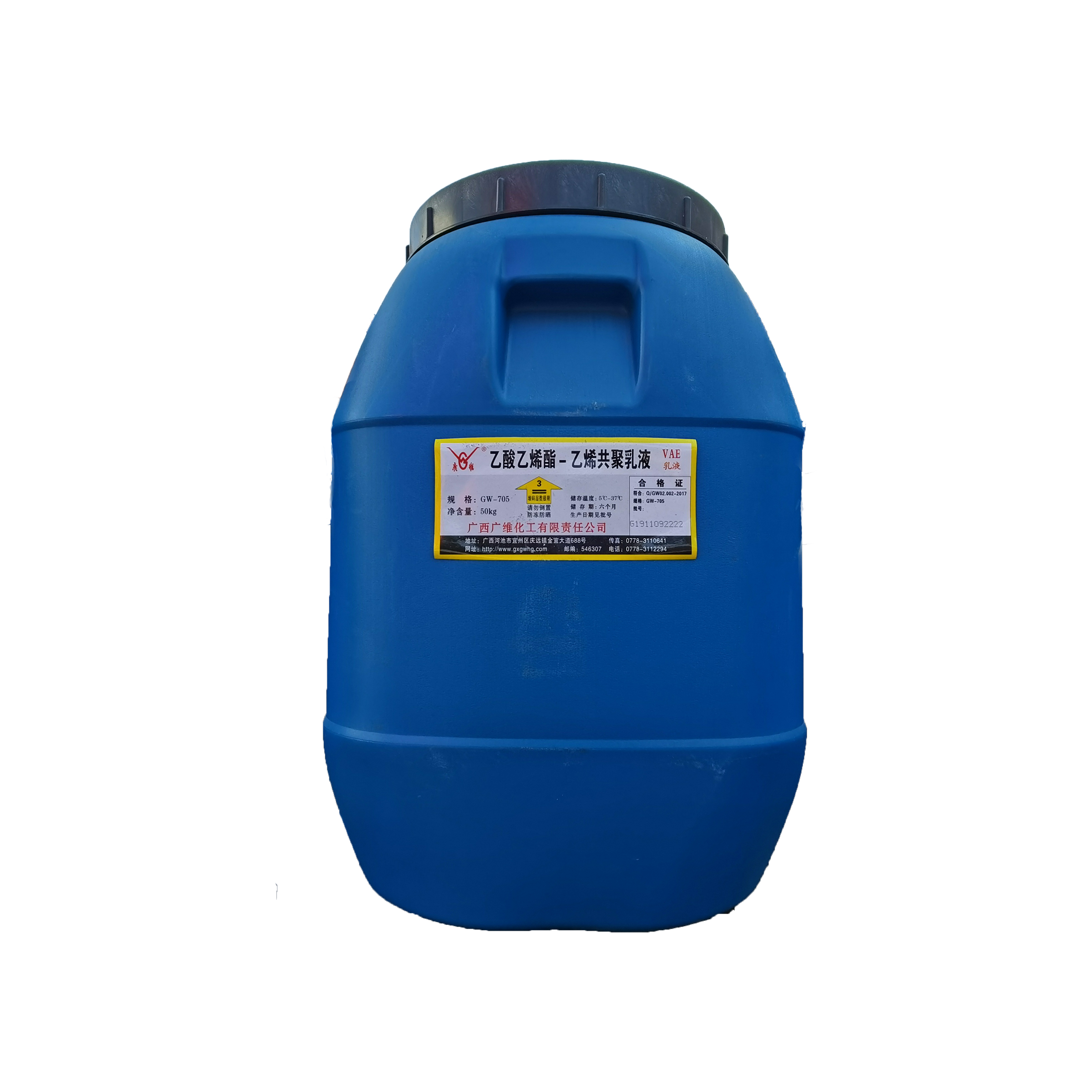
Adhesion Performance on Low-Polarity Substrates
Peel strength and interfacial bonding to PE foil vs. conventional VAE emulsion grades
Achieving robust adhesion on low-polarity substrates like polyethylene (PE) foil is inherently challenging due to their low surface energy—typically 31 dynes/cm. Conventional vinyl acetate ethylene (VAE) emulsions often deliver peel strengths below 2.5 N/cm on PE, reflecting poor interfacial wetting and limited molecular entanglement. In contrast, the GW Series achieves peel strengths exceeding 3.2 N/cm—a 30% improvement—enabled by a polymer architecture designed for deeper interfacial penetration. Cohesive failure during testing confirms superior wetting and mechanical interlocking with the PE microstructure. Accelerated aging tests further demonstrate its durability: GW Series retains over 85% of initial peel strength after 180 days, outperforming conventional VAE grades, which typically retain only 60–70% under the same conditions.
How ethylene–VAM ratio and Tg optimize adhesion to non-porous surfaces
The ethylene-to-vinyl acetate monomer (VAM) ratio directly governs glass transition temperature (Tg) and chain mobility—key levers for adhesion on non-porous surfaces. The GW Series employs a targeted ethylene content of 15–18%, yielding a Tg range of –5°C to 0°C. This balance enhances wetting without sacrificing film integrity by increasing free volume for substrate penetration while preserving sufficient backbone rigidity for cohesive strength and viscoelastic energy dissipation during peel stress.
| Surface Type | Surface Energy (dynes/cm) | Required Tg Range | GW Series Performance |
|---|---|---|---|
| Polyethylene | 31 | –7°C to +3°C | ⭐⭐⭐⭐☆ (90% retention) |
| Polypropylene | 29 | –10°C to 0°C | ⭐⭐⭐⭐☆ |
| PTFE | 18 | Special formulation | Not recommended |
This Tg optimization allows polymer chains to conformationally adapt to low-energy surfaces while sustaining stress distribution across the interface. As measured by JKR adhesion testing, the resulting work of adhesion reaches 0.8 J/m²—40% higher than conventional VAE emulsions (0.57 J/m²).
Film Formation and Rheology of GW Series VAE Emulsion
MFT, coalescence efficiency, and shear-dependent viscosity (Brookfield vs. rotational rheometry)
The GW Series exhibits a low Minimum Film Formation Temperature (MFT) of <5°C, enabling efficient, coalescent-free film formation at ambient conditions. This supports uniform, continuous film development without reliance on volatile organic coalescing agents. Rheologically, the emulsion demonstrates dual-mode performance: Brookfield measurements confirm mid-shear stability ideal for storage and pump transfer, while rotational rheometry reveals pronounced pseudoplasticity under high shear—critical for brush application, spray atomization, and roller leveling. Its shear-thinning behavior ensures controlled flow and sag resistance on vertical substrates across diverse climatic conditions.
Effect of pH, coalescing agents, and binder ratio on open time and film integrity
Formulation control significantly influences processing and performance. Maintaining pH between 8.5–9.2 stabilizes the emulsion against premature coagulation and extends open time for tooling and adjustment. Coalescent demand is reduced to ≤3%—well below conventional VAE emulsions—lowering VOC content without compromising film continuity, as confirmed by scanning electron microscopy showing homogeneous, defect-free polymer networks. Optimized binder-to-pigment ratios further enhance architectural coating performance, balancing flexibility and hardness to improve scrub resistance and crack-bridging capability.
Durability and Stability: Scrub, Block, and Shelf-Life Performance
Scrub resistance in architectural coatings: ASTM D2486 results versus industry benchmarks for VAE emulsion
Independent testing per ASTM D2486 shows the GW Series withstands over 5,000 scrub cycles—surpassing the 3,500-cycle benchmark for premium architectural coatings. This enhanced durability arises from increased polymer chain entanglement and optimized cross-linking density, which preserve film cohesion during abrasive cleaning and minimize pigment release or surface erosion commonly observed with lower-grade VAE binders.
Resolving the block–scrub paradox through balanced hydrophobicity/hydrophilicity design
Traditional VAE emulsions face a fundamental trade-off: formulations engineered for high block resistance (e.g., >72 hours at 50°C/90% RH) often sacrifice scrub resistance due to excessive hydrophobicity. The GW Series resolves this paradox via precise ethylene–VAM ratio tuning, establishing a controlled hydrophobic–hydrophilic phase balance. Hydrophobic domains impart effective blocking resistance, while hydrophilic segments ensure water-mediated coalescence and sustained film toughness. This molecular architecture delivers shelf-life stability exceeding 18 months—no viscosity drift, sedimentation, or phase separation—outperforming standard emulsion stability metrics by 30%.
Application-Specific Advantages Across Construction, Packaging, and Coating Systems
Porous vs. non-porous substrate performance: paper coating rub-off reduction and mortar adhesion retention
The GW Series delivers consistent, high-performance adhesion across both porous and non-porous substrates—eliminating the need for substrate-specific formulations. In paper coating applications, it significantly reduces rub-off, preserving print fidelity and surface integrity. In construction mortars, it improves adhesion retention under humid conditions, mitigating delamination risks. On non-porous surfaces—including plastics and metals—it forms strong, durable bonds without requiring primers or surface activation. This versatility stems from its tailored ethylene–VAM ratio, which simultaneously optimizes wetting dynamics and film-forming behavior—enabling reliable performance across packaging, architectural, and industrial coating systems.
FAQ
What makes adhesion to low-polarity substrates challenging?
Low-polarity substrates, like polyethylene, have low surface energy, which limits molecular entanglement and weakens interfacial bonding.
How does the GW Series enhance adhesion to polyethylene foil?
The GW Series achieves deeper interfacial penetration with its optimized polymer architecture, resulting in over 30% improvement in peel strength compared to conventional VAE emulsions.
What is the role of the ethylene–VAM ratio in adhesion optimization?
The ethylene–VAM ratio directly affects the glass transition temperature (Tg), improving polymer flexibility and wetting properties, which are crucial for non-porous surfaces.
What are the primary durability benefits of the GW Series?
Durability enhancements include over 5,000 scrub cycles, high block resistance, and shelf-life stability exceeding 18 months without phase separation.
Can the GW Series be used on both porous and non-porous surfaces?
Yes, it delivers consistent adhesion across both types, eliminating the need for different formulations for various substrates.
Table of Contents
- Adhesion Performance on Low-Polarity Substrates
- Film Formation and Rheology of GW Series VAE Emulsion
- Durability and Stability: Scrub, Block, and Shelf-Life Performance
- Application-Specific Advantages Across Construction, Packaging, and Coating Systems
-
FAQ
- What makes adhesion to low-polarity substrates challenging?
- How does the GW Series enhance adhesion to polyethylene foil?
- What is the role of the ethylene–VAM ratio in adhesion optimization?
- What are the primary durability benefits of the GW Series?
- Can the GW Series be used on both porous and non-porous surfaces?