 EN
EN

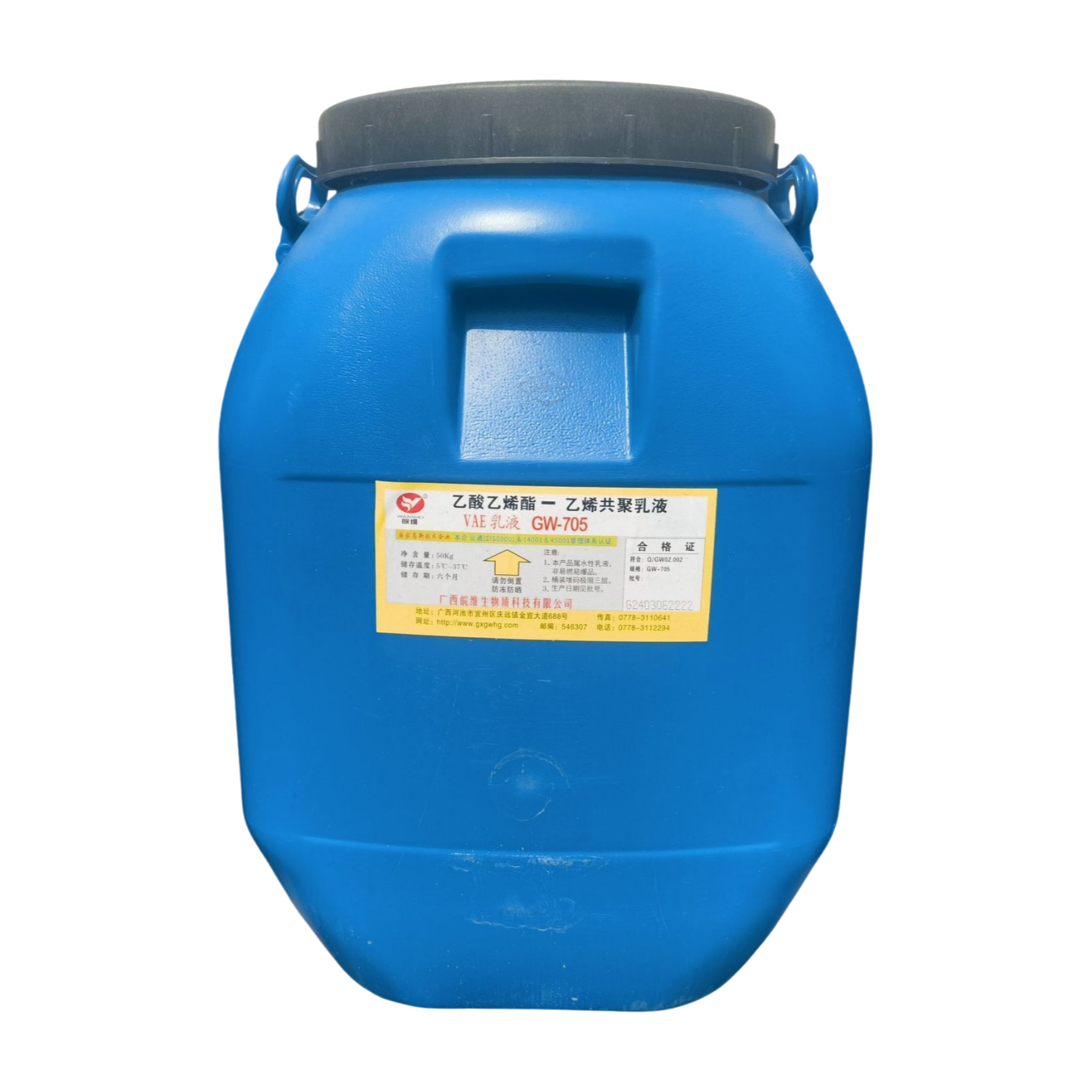
Film Formation and Adhesion Performance of VAE Emulsions
The film formation and adhesion characteristics of VAE emulsions are central to their performance in coatings. Two key parameters—minimum film-forming temperature (MFFT) and particle size—govern how the emulsion coalesces into a continuous, adherent film.
How MFFT and particle size govern film continuity and substrate bonding
MFFT defines the lowest temperature at which a VAE emulsion can coalesce into a continuous film. A low MFFT—typically near 5°C—enables reliable film formation in cold environments without cosolvents. Particle size directly affects packing density and interparticle fusion during drying: smaller particles yield tighter, more homogeneous films with fewer voids, resulting in smoother surfaces and improved contact with the substrate. The polar ester groups in the vinyl acetate–ethylene copolymer support molecular-level interactions—including hydrogen bonding and van der Waals forces—with diverse substrates, enhancing both film integrity and interfacial bond strength.
Adhesion strength on challenging non-porous substrates (PVC, metal, glass)
VAE emulsions deliver strong, durable adhesion on non-porous substrates such as PVC, metal, and glass—despite the absence of mechanical interlocking. Their flexible film conforms to microscopic surface topography, maximizing effective contact area. On metal, oxygen atoms from vinyl acetate units form weak coordinative bonds with surface metal atoms; on glass and PVC, analogous polar interactions contribute to robust interfacial adhesion. Bond strengths often surpass those of conventional acrylic or PVA emulsions, making VAE emulsions a preferred choice for industrial primers and coatings applied to low-energy surfaces.
Flexibility and Moisture Resistance in VAE Emulsions
Elongation-at-break and humidity-cycled recovery behavior
Coatings based on VAE emulsions must endure repeated mechanical and environmental stress. Elongation-at-break (ASTM D2370) quantifies a film’s ability to stretch before rupture: high-performance VAE grades typically exceed 300%, enabling crack bridging and accommodation of substrate movement. Equally important is elastic recovery after humidity cycling. Under alternating high-humidity (95% RH, 40°C) and low-humidity conditions, optimized VAE films recover over 90% of their original elongation within five cycles. This resilience stems from the copolymer’s balanced soft-segment content, allowing polymer chains to reversibly slide and re-entangle without permanent plastic deformation—ensuring long-term protective function in condensing/drying environments like bathrooms or exterior façades.
Water absorption kinetics and blister resistance under accelerated weathering
Low water uptake is critical to preventing delamination and blistering in wet-service applications. VAE emulsion films absorb less than 5% water by weight after 24-hour immersion, owing to their hydrophobic ethylene backbone and fine, uniform particle morphology—which minimizes capillary pathways. Absorption follows Fickian diffusion, reaching saturation within 48 hours. Under accelerated weathering (QUV cycles combining UV-B exposure and water spray), formulations with optimized crosslink density show no blistering or delamination after 1,000 hours. Blister resistance correlates strongly with sustained adhesion under osmotic pressure—a property enhanced by the low ionic content and narrow particle-size distribution of premium VAE grades. These attributes make VAE-based coatings well suited for exterior walls, roof tiles, and swimming-pool paints.
Durability and Regulatory Compliance of VAE Emulsions
Wet-scrub resistance (ASTM D2486) across five commercial VAE emulsion grades
Wet-scrub resistance is a key indicator of functional longevity in high-traffic, washable environments such as kitchens and washrooms. Per ASTM D2486, five commercial VAE emulsion grades were evaluated for coating integrity under repetitive scrubbing. Performance varied significantly with particle size distribution and surfactant package design. Top-tier grades maintained ≥95% coating integrity after 8,000–10,000 cycles—more than double the typical failure point of conventional alternatives (~4,000 cycles). This durability arises from precise Tg modulation that balances cohesive strength with flexibility, translating directly into extended service life where frequent cleaning is required.
VOC compliance pathways and low-temperature stability (≤5°C) in storage and application
Meeting stringent regional VOC regulations—including EU VOC Directive 1999/13/EC and U.S. EPA standards—requires reformulation using solvent-free, bio-based synthesis routes. Modern VAE emulsions achieve VOC levels below 50 g/L through aqueous polymerization and optimized surfactant systems, satisfying regulatory thresholds across North America and the EU while reducing ecological impact and application hazards. Simultaneously, colloidal stabilization packages incorporating freeze-thaw carbohydrates ensure stable storage and handling at ≤5°C. These systems guarantee full post-thaw redispersibility without viscosity separation or coagulum formation—common failure modes in standard emulsions—thereby preserving batch-to-batch consistency and minimizing waste during winter logistics and application.
Application Optimization: Matching VAE Emulsions to Coating End Uses
Selecting the appropriate VAE emulsion grade is essential to achieving optimal performance in a given coating application. The inherent versatility of the vinyl acetate–ethylene copolymer allows formulators to tune key properties—including MFFT, particle size, Tg, and surfactant architecture—to meet specific end-use demands.
For interior architectural paints, a low-MFFT grade (<5°C) enables robust film formation on drywall and wood without coalescing solvents—reducing VOC emissions while delivering smooth, durable finishes. Exterior coatings require enhanced water resistance and UV stability; these are achieved through targeted modifiers that improve weatherability and suppress cracking or blistering over time. In industrial applications—such as metal or glass primers—adhesion on non-porous substrates takes priority. Here, matching particle size and stabilization chemistry to substrate energy is critical to prevent delamination. By aligning flexibility, adhesion, and moisture resistance with the operational environment, manufacturers fully leverage the functional advantages of VAE emulsions in high-performance coating systems.
FAQ
What is MFFT, and why is it important in VAE emulsions?
MFFT stands for Minimum Film-Forming Temperature, the lowest temperature at which a VAE emulsion can coalesce into a continuous film. It is crucial for ensuring smooth and effective film formation, especially in colder environments.
How do VAE emulsions adhere to non-porous substrates?
VAE emulsions adhere to non-porous substrates through molecular interactions like hydrogen bonding and van der Waals forces. Their flexibility allows them to conform to surface topography, enhancing contact and bond strength.
What makes VAE emulsions moisture-resistant?
The hydrophobic ethylene backbone and fine particle morphology minimize water uptake, preventing blistering and delamination in wet environments.
Are VAE emulsions environmentally friendly?
Yes, VAE emulsions meet stringent VOC regulations through solvent-free, aqueous polymerization, reducing ecological impact while maintaining high performance.
What are common applications for VAE emulsions?
VAE emulsions are used in interior and exterior architectural paints, industrial primers, roof coatings, and pool paints, offering properties like flexibility, moisture resistance, and strong adhesion.