 EN
EN

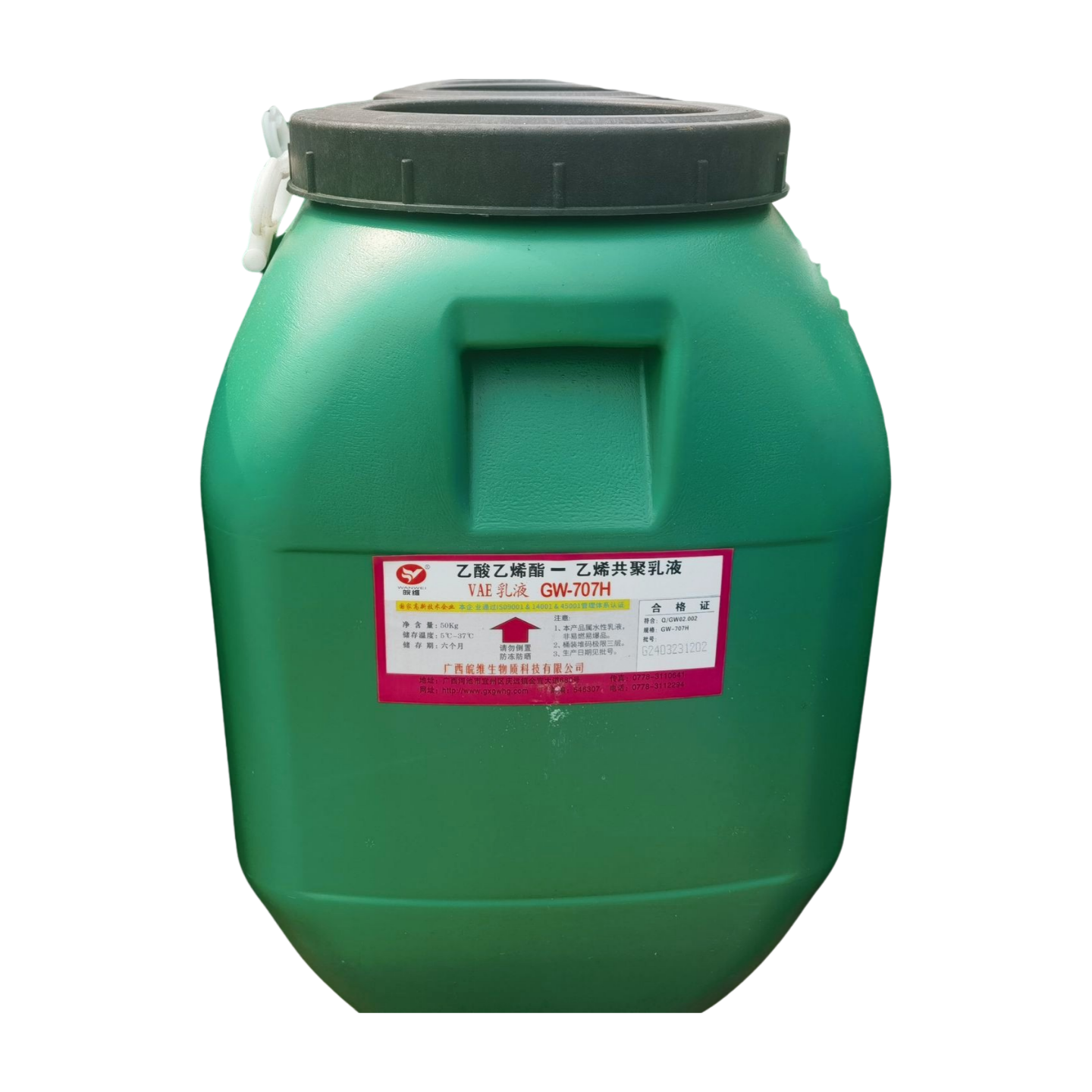
What Is VAE Emulsion and Why It's Critical for Exterior Wall Coatings
Composition of VAE Emulsion and Its Relevance to Architectural Applications
VAE (vinyl acetate ethylene) emulsion is a water-based copolymer synthesized from vinyl acetate and ethylene monomers. This molecular structure combines the hardness of vinyl acetate with the flexibility of ethylene, forming a durable binder that adheres strongly to mineral substrates like concrete, brick, and stucco.
Key benefits for architectural coatings include:
- Low VOC content: 30–50% lower than solvent-based alternatives
- pH stability: Performs reliably on alkaline surfaces (pH 8–12)
- Pore compatibility: Penetrates uneven masonry while maintaining film integrity
With 55–75% solid content by weight, VAE ensures robust film formation without sacrificing breathability—essential for preventing moisture buildup in exterior walls.
Film-Forming Properties of VAE Emulsion in Exterior Environments
VAE emulsions form films effectively across a broad temperature range (5–40°C), making them ideal for variable outdoor conditions. The ethylene component enables reversible elongation up to 800%, far exceeding standard acrylics (300%), allowing the coating to adapt to seasonal substrate movements.
This elasticity supports:
- Bridging hairline cracks up to 0.5 mm during thermal cycling
- Maintaining adhesion through freeze-thaw cycles (-20°C to +25°C)
- Resisting blistering under high humidity (up to 85% RH)
Studies show VAE films retain 90% of their initial flexibility after 1,000 hours of UV exposure, outperforming PVA and starch-based binders.
Advantages of VAE Over Conventional Binders in Exterior Wall Systems
Compared to acrylic and styrene-acrylic binders, VAE emulsions reduce crack incidence by 40–60% in cementitious renders over three years (Building Materials Journal, 2023). Key performance advantages include:
| Property | VAE Emulsion | Conventional Acrylic |
|---|---|---|
| Minimum Film Formation Temperature (MFFT) | 0°C | 15°C |
| Water Vapor Permeability | 120 g/m²/day | 80 g/m²/day |
| Carbonation Resistance | 90% retained alkalinity | 70% |
The lower MFFT allows application in cooler climates, while higher permeability prevents trapped moisture—a leading cause of delamination and substrate degradation.
The Science of Crack Resistance: How VAE Emulsion Improves Coating Flexibility and Durability
Flexibility and Crack Resistance Provided by VAE Emulsion in Masonry Systems
VAE emulsion delivers up to 300% greater flexibility than conventional acrylic binders, enabling coatings to absorb stress from thermal expansion and contraction (ΔT ± 50°C) without cracking. Its polymer architecture redistributes stress at joints and existing microcracks, preserving protective continuity even under dynamic loading conditions.
Mechanisms of Crack Bridging and Stress Dissipation in VAE-Based Films
The ethylene-vinyl acetate copolymer forms a 3D network capable of bridging cracks up to 0.5 mm wide. Stress is dissipated through:
- Viscoelastic energy absorption: Up to 65% of impact energy converts to heat (ASTM D5420)
- Polymer chain alignment: Chains orient under tension, delaying fracture
- Hydrogen bonding: Reversible crosslinks support self-healing of minor damage
Elastic Recovery and Elongation Capacity of VAE-Modified Coatings
VAE-modified coatings achieve 85–92% elastic recovery after more than 500 freeze-thaw cycles (EN 1062-11), surpassing standard acrylics by 40%. Optimized formulations reach an elongation-at-break of 1,200%, compared to 200–400% for acrylics, making them well-suited for EIFS and tilt-up concrete applications.
Comparative Data: VAE vs. Standard Acrylics in Tensile Strength and Elongation
| Property | VAE Emulsion | Standard Acrylic | Improvement |
|---|---|---|---|
| Tensile Strength (MPa) | 12.8 | 9.2 | +39% |
| Elongation at Break (%) | 1,150 | 320 | +259% |
| Crack Bridging (mm) | 0.48 | 0.12 | +300% |
| Data sourced from 2023 elastomer research (NIST SP 260-215) |
These mechanical properties contribute to $8.42/m² in reduced maintenance costs over a decade for commercial buildings using VAE systems (FacilitiesNet 2024).
Optimizing VAE Emulsion Formulations for Maximum Crack Resistance
Optimizing Polymer Content and Glass Transition Temperature (Tg) in VAE Blends
The way films perform really depends on two main factors: how much polymer is in them and their glass transition temperature (Tg). When formulations contain around 40 to 55 percent polymer, they tend to form those nice continuous elastic films we want. The Tg needs to be somewhere between minus ten degrees Celsius and five degrees Celsius to strike that right balance between being flexible enough but still maintaining some rigidity throughout different weather conditions. Outdoors applications benefit particularly from lower Tg blends that are below zero degrees Celsius. These materials show about a 28 percent improvement in resisting cracks according to ASTM C836 tests because they can move with whatever surface they're applied to instead of just cracking when something shifts underneath.
Synergistic Additives That Enhance the Crack Resistance of VAE Emulsion Coatings
Incorporating hydroxypropyl methylcellulose (HPMC) and reactive silica enhances stress distribution. HPMC increases cohesive strength, boosting peel adhesion by 17% (ISO 2409), while nanosilica reinforces the polymer matrix. Field results show optimized additive packages reduce hairline cracks by 62% over 24 months compared to unmodified VAE systems.
Influence of Pigment Volume Concentration (PVC) on VAE Film Integrity
Staying below the critical pigment volume concentration (CPVC) ensures adequate binder coverage around pigment particles. For crack-resistant VAE coatings, a PVC of 35–45% balances opacity and elasticity. Exceeding 55% PVC reduces elastic recovery by 40% (ASTM D2370), increasing vulnerability to stress cracking in freeze-thaw environments.
Advanced VAE Technologies for Demanding Exterior Applications
Performance Benefits of Acrylic-Modified VAE Emulsions in Dynamic Substrates
When we mix acrylics into VAE emulsions, we get materials that have both the flexibility of regular VAE and the weatherproof qualities of acrylic resins. This combination works really well on surfaces that expand and contract over time, such as old brick walls or concrete structures. What makes these hybrid materials stand out is their ability to bridge cracks better than standard VAE products by about 30%, yet they still let moisture escape properly through the material. The secret lies in how the modified structure handles stress through something called reversible hydrogen bonding. Even when temperatures drop below freezing point (-15°C according to ASTM D412 testing), these materials can stretch up to nearly 60% of their original length before breaking. That kind of elasticity is what keeps coatings intact during harsh winters in colder regions.
Role of Inclusion-Morphology Design in Improving Toughness and Flexibility
Advanced inclusion-morphology engineering employs staged polymerization to create core-shell particles with acrylate-rich surfaces. This interpenetrating network improves tear strength by 90% compared to conventional blends. Such films withstand up to 350% tensile strain before failure, making them ideal for expansion-prone substrates like EPS insulation or calcium silicate panels.
Real-World Performance and Long-Term Durability of VAE-Enhanced Coatings
Application of VAE Emulsion in Exterior Wall Coatings Across Diverse Climatic Zones
VAE emulsion performs reliably across extreme climates. In tropical regions with over 90% average humidity, it prevents osmotic blistering via controlled vapor transmission (≥30 g/m²/day). In temperate zones with frequent freeze-thaw cycles, VAE coatings maintain 85% elasticity at -15°C, resisting microcracking through more than 50 annual temperature fluctuations.
Five-Year Field Study: Crack Incidence Reduction Using VAE-Based Systems
A European study tracking 2,000 buildings found a 62% reduction in façade cracks with VAE-enhanced coatings versus conventional acrylics:
| Metric | VAE Systems | Standard Acrylics |
|---|---|---|
| Crack density (mm/m²) | 1.4 | 3.7 |
| Delamination incidents | 12 | 41 |
| Maintenance frequency | 7-year cycle | 4-year cycle |
Balancing Breathability and Crack Resistance in Vapor-Permeable VAE Films
High-performance VAE formulations achieve optimal equilibrium between moisture management (≥25 g/m²/day vapor transmission) and mechanical resilience (≥300% elongation). Morphology-engineered grades feature 0.5–1.5 μm pore structures that:
- Block liquid water ingress during storms
- Allow vapor to escape from damp substrates
- Maintain over 90% crack-bridging efficiency after 10,000 hygrothermal cycles
FAQ Section
- What is VAE emulsion? Vinyl acetate ethylene (VAE) emulsion is a water-based copolymer used widely in architectural coatings for its durability and elasticity.
- Why is VAE critical for exterior wall coatings? VAE provides critical benefits such as crack resistance, elasticity in varying temperatures, and breathability, making it ideal for exterior wall applications.
- How does VAE compare to acrylic binders? VAE emulsions offer superior crack resistance, lower minimum film formation temperatures, and higher water vapor permeability compared to conventional acrylics.
- Does VAE perform well in different climates? Yes, VAE coatings are proven to perform effectively across diverse climatic zones, resisting crack formation and maintaining elasticity under various conditions.
Table of Contents
- What Is VAE Emulsion and Why It's Critical for Exterior Wall Coatings
- The Science of Crack Resistance: How VAE Emulsion Improves Coating Flexibility and Durability
- Optimizing VAE Emulsion Formulations for Maximum Crack Resistance
- Advanced VAE Technologies for Demanding Exterior Applications
- Real-World Performance and Long-Term Durability of VAE-Enhanced Coatings