 EN
EN

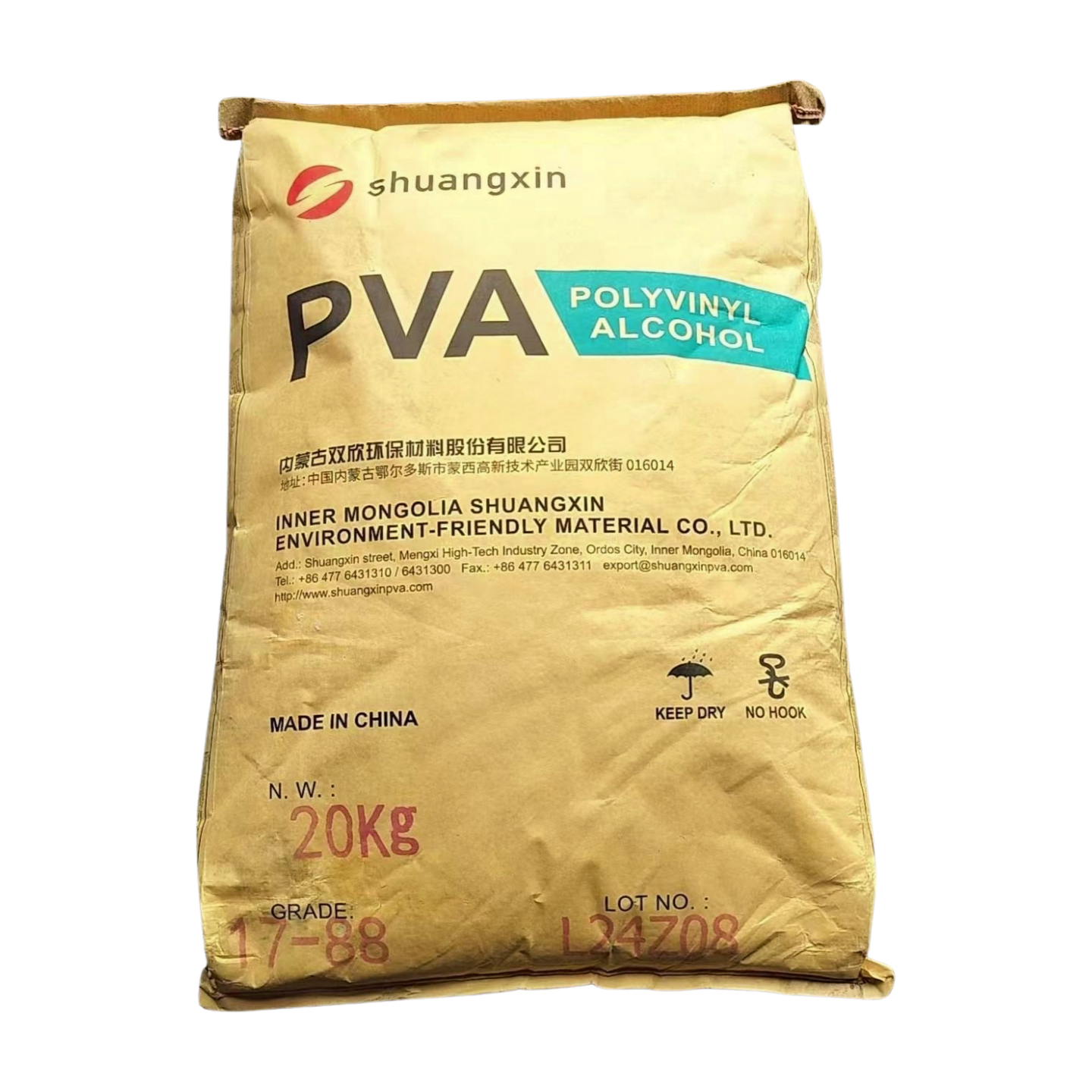
Core Properties of PVA 1788 That Define Sizing Performance
Alcoholysis degree (88%) and polymerization degree: impact on film strength and flexibility
PVA 1788’s 88% alcoholysis degree signifies partial hydrolysis—retaining a precise balance of acetate groups for cohesion and hydroxyl groups for water solubility and fiber adhesion. This molecular architecture yields a film that is both strong and flexible, critical for protecting warp yarns during high-speed weaving. Its medium viscosity (21.0–24.5 mPa·s in 4% aqueous solution at 20°C) reflects a moderate polymerization degree, enabling sufficient chain entanglement for high tensile strength while allowing elongation under dynamic loom stress. For cotton–polyester blends, this balance minimizes end-breakage and lint shedding; sized yarns show a 25–30% reduction in hairiness versus unsized counterparts, directly boosting weaving efficiency. The resulting film resists cracking during bending and abrasion—key to maintaining integrity at high loom speeds without excessive size shedding.
Solubility profile and controlled desizability in industrial washing processes
PVA 1788 dissolves readily in cold water (≥20°C), a direct result of its 88% hydrolysis level and moderate molecular weight. This cold-water solubility enables complete, residue-free removal in standard industrial wash baths—over 99% desizing achieved within 15 minutes at 40°C—eliminating the need for enzymatic or oxidative treatments. The dual functionality of its hydrophilic hydroxyl and hydrophobic acetate groups governs its behavior: acetate groups temper water uptake during weaving to prevent premature dissolution, while abundant hydroxyls drive rapid rehydration and dispersion in the wash. This controlled desizability cuts water and energy use by up to 20% compared to starch-based systems and ensures a clean, uniform fabric surface ideal for dyeing and finishing.
Matching PVA 1788 to Fiber Type and Weaving Requirements
Why PVA 1788 excels for cotton-polyester blends and high-speed weaving
PVA 1788’s molecular duality—hydroxyl groups for hydrogen bonding with cotton cellulose and acetate groups for affinity with polyester—enables uniform, cohesive film formation across blended yarns, a challenge for single-affinity sizing agents. In high-speed air-jet looms (≥850 rpm), its film delivers exceptional tensile strength and elongation, resisting disintegration under cyclic tension and abrasive forces in the weaving shed. Field data from a leading textile research institute confirms that for fabrics with up to 60% polyester content, PVA 1788 significantly suppresses sizing dust generation during beating-up, sustaining weaving efficiency above 92% (2023).
Limitations with pure synthetics or low-tension fabrics requiring lower-viscosity alternatives
PVA 1788 is less effective on 100% synthetic filament yarns (e.g., polyester or nylon), whose smooth, nonpolar surfaces limit adhesion of its relatively hydrophilic film—potentially causing size shedding. For such applications, a more hydrophobic grade (e.g., highly hydrolyzed PVA with finer particle size) is preferred. Similarly, on low-tension or fine-count yarns, its medium viscosity can hinder full penetration into dense, low-twist bundles, leaving the core under-sized and prone to internal slippage. In these cases, a lower-viscosity alternative like PVA 0588 forms a thinner, more penetrating film—ensuring complete fiber bonding without excessive add-on, preserving fabric hand feel and reducing desizing burden.
PVA 1788 vs. Key Alternatives: When to Choose It Over 1799, 0588, or 2488
Trade-offs: viscosity, adhesion, and desizing efficiency across common PVA grades
Selecting the optimal PVA grade hinges on balancing film-forming viscosity, fiber adhesion, and desizing efficiency—each tied directly to yarn composition and loom speed. An ill-suited grade risks defects like warp hairiness or brittle film failure. The table below summarizes key differentiators:
| PVA Grade | Key Characteristics | Viscosity (4% solution, 20°C) | Adhesion Strength | Desizing Efficiency | Primary Application Scenario |
|---|---|---|---|---|---|
| PVA 1788 | Balanced profile, partial hydrolysis | 20.0–26.0 mPa·s | High for staple fibers | High (easy cold-water dispersible) | Cotton-polyester blends, high-speed looms |
| PVA 1799 | Fully hydrolyzed, high crystallinity | 25.0–31.0 mPa·s | Very High | Low (requires hot water >90°C) | Pure cotton, where maximum abrasion resistance is critical |
| PVA 0588 | Low viscosity, partial hydrolysis | 5.0–7.0 mPa·s | Low | Very High | Low-tension, fine-count fabrics; acts as a plasticizer |
| PVA 2488 | High polymerization degree | 40.0–50.0 mPa·s | High | Moderate | Heavy fabrics requiring a thick, tough film |
The central trade-off lies between adhesion and desizability. While PVA 1799 offers superior film toughness, its desizing demands high-temperature washing (>90°C), often yielding incomplete removal and residual stiffness. PVA 1788 delivers a pragmatic compromise: robust adhesion for blended yarns paired with >95% desizing efficiency in standard wash conditions—critical for dye uniformity and process sustainability. Its viscosity also aligns precisely with high-speed staple-fiber weaving, avoiding the brittleness of over-concentrated films or the poor encapsulation of ultra-low-viscosity grades.
Optimizing PVA 1788 Usage: Concentration, Temperature, and Compatibility Tips
Effective sizing with PVA 1788 requires tight control of concentration, temperature, and additive compatibility. A 6–10% solids concentration typically achieves optimal film strength and flexibility: finer yarns (40s–60s Ne) perform best at the lower end; coarser counts (10s–20s Ne) may require up to 10% to withstand higher loom tension. Exceeding 12% risks a stiff, brittle film that impairs weaving efficiency and complicates desizing.
Temperature management is equally vital. Full hydration demands heating water to 80–90°C under continuous agitation for 30–60 minutes—preventing undissolved gel particles that clog size boxes or create weak spots. Once dissolved, maintain the bath at 60–70°C to ensure low viscosity for deep yarn penetration and uniform coating, while avoiding thermal degradation. Rapid cooling increases viscosity, promoting surface buildup and inconsistent shedding on the loom.
PVA 1788 integrates well with common additives: it compatibly blends with oxidized starches, carboxymethyl cellulose (CMC), and acrylic binders—enabling cost-effective hybrid formulations. Adding 0.5–1% non-ionic wax emulsion reduces friction and static; stability in pH 5–7 means strong acids or alkalis must be avoided to prevent polymer hydrolysis. In high-shear systems, a silicone-free defoamer prevents air entrapment without desizing interference. A mill trial by a leading textile research center demonstrated that an 8% PVA 1788 / 4% modified starch / 0.8% lubricant blend increased weaving efficiency by 18% versus starch-only sizing under identical loom conditions (2023).
FAQ
Q1: Why is PVA 1788 suitable for cotton-polyester blends?
A: PVA 1788’s molecular structure combines hydroxyl groups for bonding with cotton and acetate groups for compatibility with polyester, forming a cohesive film ideal for blended yarns.
Q2: What makes PVA 1788 dissolve easily in cold water?
A: Its 88% hydrolysis degree and moderate molecular weight allow it to dissolve efficiently, ensuring residue-free removal during industrial washing.
Q3: Can PVA 1788 be used for 100% synthetic yarns?
A: PVA 1788 is less effective for synthetic filament yarns due to limited adhesion properties; highly hydrolyzed grades may work better for such applications.
Q4: How can the optimal concentration of PVA 1788 be determined?
A: A concentration of 6–10% solids is recommended, with finer yarns requiring lower levels and coarser yarns needing higher levels under high loom tension.
Q5: How does PVA 1788 compare to other PVA grades?
A: Compared to alternatives like PVA 1799 or 0588, PVA 1788 balances adhesion, flexibility, and desizing efficiency for high-speed weaving with blended fibers.