 EN
EN

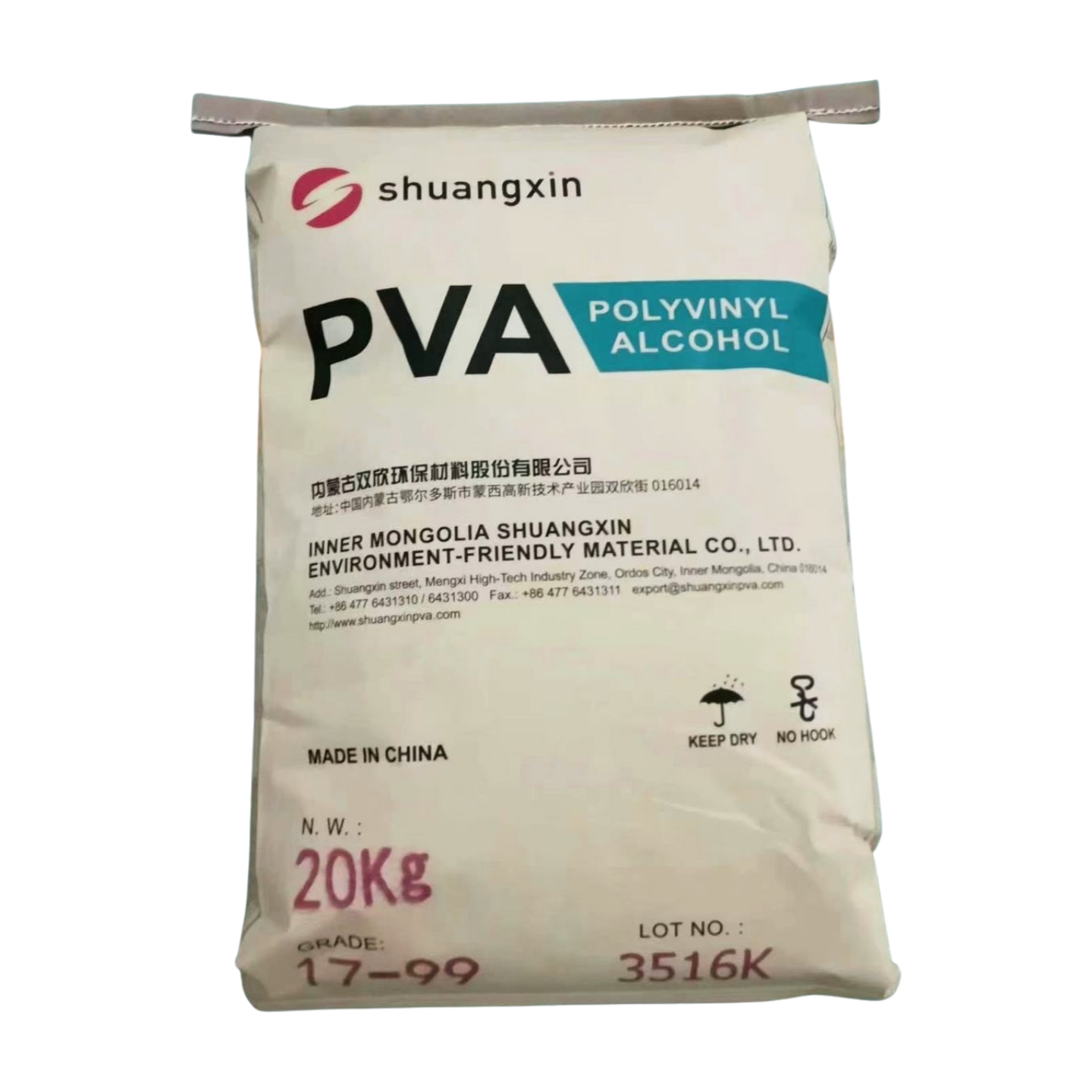
What Is Polyvinyl Alcohol? Chemical Structure and Key Properties
Polyvinyl alcohol (PVA) is a synthetic, water-soluble polymer with the chemical formula (C₂H₄O)ₙ, where n denotes the degree of polymerization. It is produced by hydrolyzing polyvinyl acetate—replacing acetate groups with hydroxyl groups—to yield a chain of repeating vinyl alcohol units. This hydrophilic structure grants PVA its hallmark traits: excellent water solubility, strong film-forming capability, high tensile strength, and robust adhesion to diverse substrates.
Solubility depends critically on the degree of hydrolysis (typically 87–99%) and molecular weight. Higher hydrolysis increases crystallinity and water resistance; lower hydrolysis enhances dissolution rate. The backbone contains predominantly 1,3-diol linkages—with minor 1,2-diol configurations—affecting flexibility, thermal stability, and mechanical performance. PVA forms transparent, flexible films resistant to oils, greases, and most organic solvents, though it degrades under strong acidic or alkaline conditions.
Supplied as odorless white granules or aqueous solutions, PVA is non-toxic and biocompatible. Regulatory approvals—including FDA clearance for food-contact applications and GRAS status—reflect its safety profile. Under aerobic conditions, it is biodegradable via microbial action, supporting its use in environmentally sensitive applications. Manufacturers precisely tune hydrolysis level and molecular weight to optimize properties like dissolution kinetics, film elasticity, or binding strength—making PVA a uniquely adaptable material across packaging, pharmaceuticals, textiles, and biomedical engineering.
Manufacturing Process and Environmental Profile of Polyvinyl Alcohol
PVA is synthesized in two controlled steps: first, vinyl acetate monomers undergo free-radical polymerization to form polyvinyl acetate; second, this intermediate undergoes alcoholysis (hydrolysis or saponification) in methanol or ethanol using acid or base catalysts. Acetate groups are replaced by hydroxyl groups, yielding the final PVA polymer. The degree of hydrolysis—ranging from ~87% (partially hydrolyzed, highly soluble) to ~99% (fully hydrolyzed, slower-dissolving)—directly governs solubility, crystallinity, and mechanical behavior.
Environmentally, PVA stands apart from conventional plastics due to its inherent water solubility and biodegradability. OECD 301B testing confirms over 60% biodegradation within 28 days in activated sludge under aerobic conditions. While dissolution in water is not equivalent to mineralization, full degradation occurs in properly managed biological treatment systems. Its non-toxicity and lack of persistent metabolites further bolster its sustainability credentials—particularly for single-use applications where end-of-life management is critical. That said, real-world environmental benefit hinges on infrastructure: without wastewater treatment, dissolved PVA may persist in aquatic environments. As circular economy goals intensify, manufacturers are optimizing production energy use and exploring closed-loop recycling pathways to reduce carbon intensity and enhance lifecycle performance.
Major Industrial Applications of Polyvinyl Alcohol
Water-Soluble Films and Packaging
PVA’s ability to form strong, transparent, fully water-soluble films makes it ideal for unit-dose packaging—especially for detergents, agrochemicals, and dyes. These films safely encapsulate active ingredients, dissolve completely upon contact with water, leave no residue, and eliminate direct handling of hazardous substances. By replacing conventional plastic pouches, PVA-based packaging reduces post-use plastic waste. Market growth reflects this advantage: water-soluble laundry pods expanded over 20% annually in 2022, driven by consumer demand for convenience and sustainability. Similarly, agricultural pesticide sachets leverage PVA for precise, low-exposure dosing—aligning with global trends toward safer, more efficient application methods.
Textile Sizing and Paper Coating
In textiles, PVA serves as a high-performance warp sizing agent, coating yarns to reduce friction and breakage during high-speed weaving. Its durable, uniform film improves weaving efficiency by 15–20% and is easily removed with hot water post-weaving—leaving no toxic residues and requiring minimal energy for desizing. In paper manufacturing, PVA functions as both binder and surface coating, significantly enhancing gloss, smoothness, tensile strength, and printability. Industrial data show PVA-coated paper achieves up to 40% higher burst strength than untreated stock, while also improving ink adhesion for premium graphic applications. Its compatibility with existing production lines and low environmental footprint make it a sustainable alternative to synthetic latex or starch-based sizings.
Pharmaceutical and Biomedical Uses
PVA’s biocompatibility, tunable dissolution profile, and capacity to form hydrogels underpin its growing role in healthcare. It enables pH-responsive enteric coatings for controlled-release oral drugs, ensuring targeted delivery in the intestine. In wound care, PVA hydrogels maintain a moist healing environment and can be loaded with antimicrobials—enhancing infection control without cytotoxicity. Ophthalmology relies on PVA for soft contact lenses and artificial tear formulations, leveraging its high oxygen permeability and ocular comfort. Additionally, PVA microspheres serve as embolization agents in interventional radiology, offering predictable particle size and biostability. With the global PVA biomedical market projected to reach $1.2 billion by 2028, innovation continues in drug delivery systems, tissue engineering scaffolds, and regenerative medicine platforms.
Safety, Handling, and Regulatory Considerations for Polyvinyl Alcohol
Polyvinyl alcohol is classified as low-hazard: it holds FDA clearance for specific food-contact uses and GRAS status, reflecting its favorable toxicological profile. Nevertheless, safe industrial handling requires attention to physical form—particularly dry powder, which poses inhalation and eye-irritation risks. Workers should wear nitrile gloves and chemical-resistant goggles; local exhaust ventilation is recommended during powder handling to control airborne particles. Dissolved PVA solutions can create slippery surfaces, so prompt spill cleanup is essential. Though non-flammable, thermal decomposition above 200°C releases acrid vapors—including acetaldehyde—so fire suppression equipment must be accessible.
Storage requires cool, dry conditions in sealed, moisture-proof containers to prevent clumping and viscosity loss. All containers must be clearly labeled, and Safety Data Sheets (SDS) readily available per OSHA requirements. Employee training on safe handling, emergency response, and waste disposal reinforces compliance with occupational health standards. Importantly, PVA’s biodegradability under aerobic conditions contributes meaningfully to its positive environmental assessment—though regulatory oversight remains active, with agencies including the FDA and ECHA continuing to monitor long-term ecotoxicological data. Adherence to these practices ensures operational safety, regulatory alignment, and responsible stewardship across its lifecycle.
FAQ Section
What is polyvinyl alcohol made of?
Polyvinyl alcohol (PVA) is synthesized by hydrolyzing polyvinyl acetate, converting acetate groups into hydroxyl groups to create a water-soluble polymer.
Is PVA biodegradable?
Yes, PVA is biodegradable under aerobic conditions, with over 60% degradation confirmed in OECD 301B testing in activated sludge.
What are common uses of polyvinyl alcohol?
PVA is widely used in water-soluble packaging, textile sizing, paper coatings, pharmaceutical delivery systems, and biomedical applications.
How should polyvinyl alcohol be stored?
PVA should be stored in cool, dry conditions within sealed moisture-proof containers to prevent clumping and loss of viscosity.
Is polyvinyl alcohol safe for human contact?
PVA is considered non-toxic and biocompatible and is FDA-approved for specific food-contact applications.