 EN

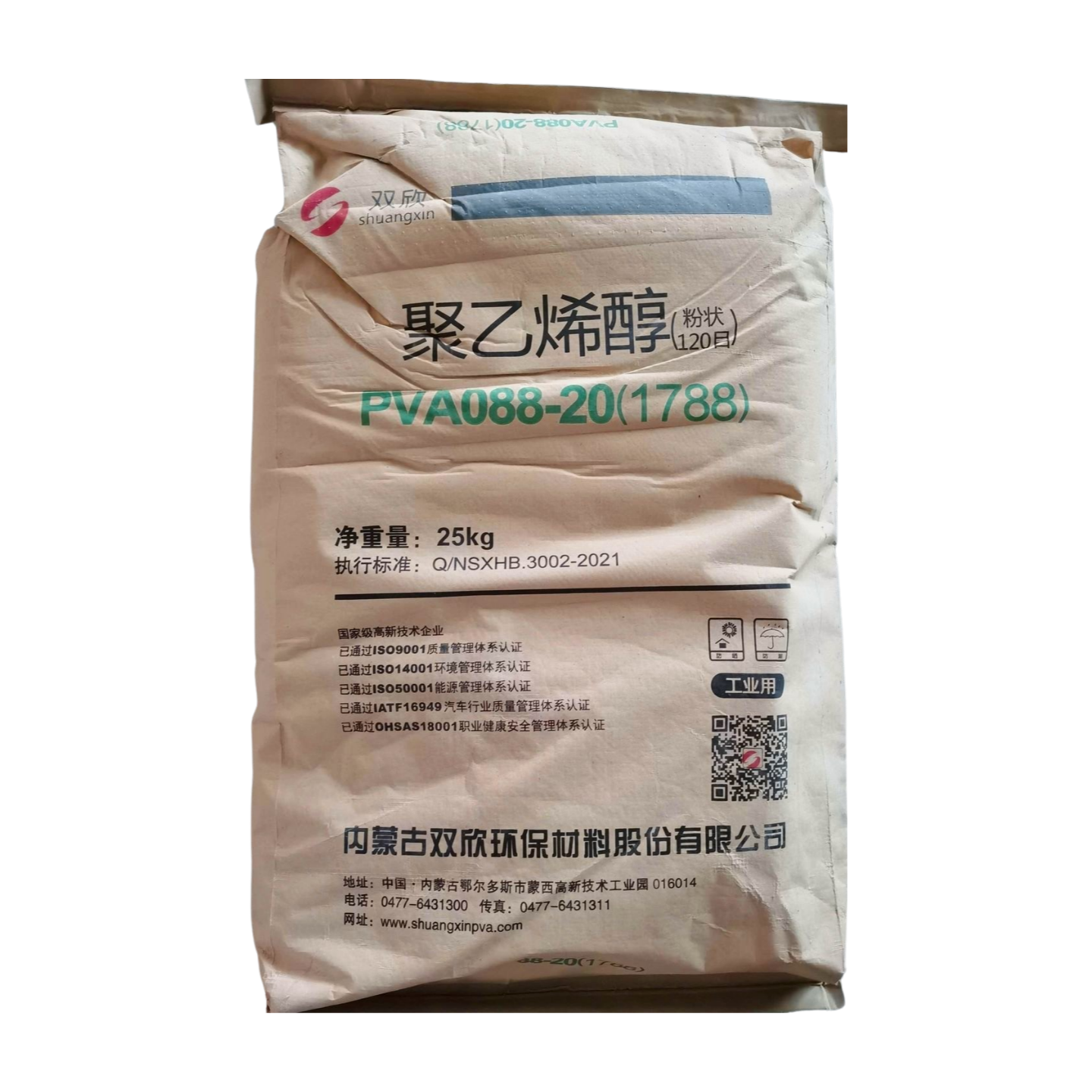
PVA 217 Molecular Profile: Why It Enables High-Viscosity Performance
Degree of Polymerization and High-MW Contribution to Solution Viscosity
The high-viscosity performance of PVA 217 is rooted in its elevated degree of polymerization (DP), typically exceeding 2000. Longer polymer chains increase entanglement density in solution, directly amplifying resistance to flow. As predicted by the Mark–Houwink relationship—where intrinsic viscosity scales with molecular weight to the power of ~0.6–0.8 for PVA in water—this high DP yields substantially greater solution viscosity at equivalent concentrations compared to lower-DP grades like PVA 17–88. At 4 % solids, PVA 217 delivers Brookfield viscosities of 25–30 mPa·s, while a 1700-DP analogue reaches only 12–15 mPa·s. These extended chains also enhance film strength and cohesive energy—key attributes in structural adhesive applications. Critically, molecular weight distribution is tightly controlled to suppress gel particle formation, ensuring smooth application and rheological consistency. This deliberate high-MW architecture positions PVA 217 as both a primary thickener and a structural backbone in high-viscosity systems.
Hydrolysis Degree (87–89%): Balancing Solubility, Gel Strength, and Viscosity Retention
PVA 217’s 87–89% hydrolysis places it in the partially hydrolyzed category, retaining enough acetate groups to disrupt crystallinity without compromising hydrogen-bonding capacity. This balance enables cold-water solubility—eliminating the need for prolonged heating—while preserving sufficient hydroxyl-group density to form robust, inter-chain hydrogen networks upon drying. The result is strong wet tack and durable gel strength on porous substrates like wood. In contrast, fully hydrolyzed PVA (98–99%) requires hot-water dissolution and tends toward brittleness; very low hydrolysis (<80%) sacrifices viscosity retention and film integrity. The 87–89% window thus optimizes process efficiency, shelf stability, and functional performance. Leading manufacturers report that properly prepared PVA 217 solutions retain over 90% of initial viscosity after 30 days at 25 °C—a benchmark of formulation stability essential for repeatable high-viscosity performance.
Viscosity Optimization Strategies Using PVA 217
Concentration Thresholds and Nonlinear Viscosity Build-Up in Aqueous Systems
PVA 217 exhibits a pronounced concentration threshold—its critical overlap concentration (C*)—where viscosity transitions from linear to exponential growth. Below C*, typically 6–8 wt% for this high-MW grade, polymer coils remain isolated and viscosity rises roughly proportionally with concentration. Above C*, chain interpenetration forms a transient network, dramatically increasing resistance to flow. At 10 wt%, Brookfield viscosity commonly reaches 3,500–5,000 mPa·s; at 15 wt%, it surges to 12,000–16,000 mPa·s. This nonlinear response allows precise viscosity tuning through small adjustments in PVA 217 loading—without requiring auxiliary thickeners—provided dissolution is carefully controlled to prevent gel nodules.
| Concentration (wt%) | Viscosity (mPa·s at 25 °C) |
|---|---|
| 5 | 500 – 800 |
| 8 | 1,200 – 1,800 |
| 10 | 3,500 – 5,000 |
| 12 | 7,000 – 9,500 |
| 15 | 12,000 – 16,000 |
To maximize reproducibility, operators should target concentrations just above C*—achieving the desired high-viscosity plateau while avoiding excessive gelation that impedes application. Pre-swelling the powder in cold water (5–20 °C) for several hours before gradual heating is a proven method to ensure full hydration and homogeneous dispersion, minimizing lumps and delivering consistent rheology.
Synergistic Shear-Thinning via Molecular Weight Distribution Control
PVA 217 solutions inherently display pseudoplastic (shear-thinning) behavior—viscosity drops under shear stress—enabling efficient application while recovering rapidly afterward. Dynamic light scattering (DLS) confirms a well-dispersed state (polydispersity index < 0.38), supporting stable viscosity under agitation. For high-speed processes like roller coating, blending PVA 217 with a low-MW PVA (e.g., DP ~500) at a 70:30 ratio broadens the molecular weight distribution and enhances shear-thinning. Shorter chains act as internal lubricants under shear, reducing apparent viscosity at 100 s⁻¹ by 30–40% relative to a pure PVA 217 solution of matched zero-shear viscosity. This synergy preserves high static viscosity for bond development while improving substrate wet-out and penetration—particularly valuable in wood laminating where rapid, uniform coverage and immediate tack are critical.
Real-World Validation: PVA 217 in High-Viscosity Wood Adhesives
PVA 217–Starch Hybrid Formulation for Plywood Lamination (η₅₀ = 8,200 mPa·s)
Plywood lamination demands adhesives with high wet tack, controlled penetration, and robust film integrity to prevent bleed-through and starved joints. A hybrid formulation combining PVA 217 with modified starch meets these requirements effectively. In a production-scale trial, the blend achieved η₅₀ = 8,200 mPa·s—delivering the body needed for vertical layup and consistent roller coating on porous poplar veneer. The formulation leverages PVA 217’s high DP (~2,400) and 87–89% hydrolysis to build a resilient, hydrogen-bonded gel network. Starch extends open time and boosts initial tack; PVA 217 ensures final bond strength, moisture resistance, and viscosity recovery post-spread. Rheological testing confirmed strong shear-thinning behavior with rapid viscosity rebound—enabling smooth application and immediate green strength. Lap shear tests on 12% moisture-content poplar plies showed a 25% increase in strength versus conventional low-viscosity PVA adhesives. This real-world validation affirms PVA 217’s role as a reliable, high-performance backbone for demanding wood adhesive applications.
Practical Considerations for Implementing PVA 217 in High-Viscosity Applications
Successful integration of PVA 217 begins with controlled dissolution: heat to 90–95 °C with sustained agitation to fully hydrate the high-MW chains—avoiding gel fisheyes that compromise uniformity. High-shear mixing often entrains air, leading to foam that causes surface defects and weakens bond lines; adding a hydrophobic silica defoamer at 0.001–0.05 mass% effectively suppresses bubbles without clouding the film—a key advantage for optical inspection in wood laminating.
Surface tension management is equally vital for consistent wetting on porous substrates. Adjusting with polyether-modified silicone or fatty acid ester brings surface tension into the optimal 45–55 mN/m range—promoting rapid, uniform spread without over-penetration. Stability must also be addressed: PVA 217 solutions may experience ±10–15% viscosity drift over 90 days at ambient temperature. Storing in sealed, cool conditions—and avoiding acidic environments—helps preserve target rheology. When blending with fillers or crosslinkers (e.g., starch or calcium carbonate slurries), pre-neutralizing to pH 5–7 prevents localized PVA hydrolysis and maintains the ≥8,000 mPa·s viscosity required for heavy-duty wood bonding.
FAQs
What makes PVA 217 unique in high-viscosity applications?
PVA 217 stands out due to its high degree of polymerization (DP), tightly controlled molecular weight distribution, and balanced hydrolysis degree (87–89%), which collectively contribute to its superior viscosity, stability, and adhesive properties.
How does its hydrolysis degree impact performance?
The 87–89% hydrolysis degree optimizes cold-water solubility, viscosity retention, and film strength, making PVA 217 suitable for applications that require strong tack and durability without heating processes.
Why is precision in concentration critical?
Due to its nonlinear viscosity behavior above the critical overlap concentration (C*), small adjustments in concentration can significantly impact viscosity, enabling effective customization for specific applications.
How can viscosity drift be minimized for long-term storage?
Store PVA 217 solutions in sealed, cool environments away from acidic substances to maintain viscosity within ±10–15% over 90 days.
What are the best practices for dissolving PVA 217?
Pre-swelling in cold water followed by gradual heating to 90–95°C ensures full hydration and homogeneous dispersion, avoiding gel nodules or lumps.