 EN
EN

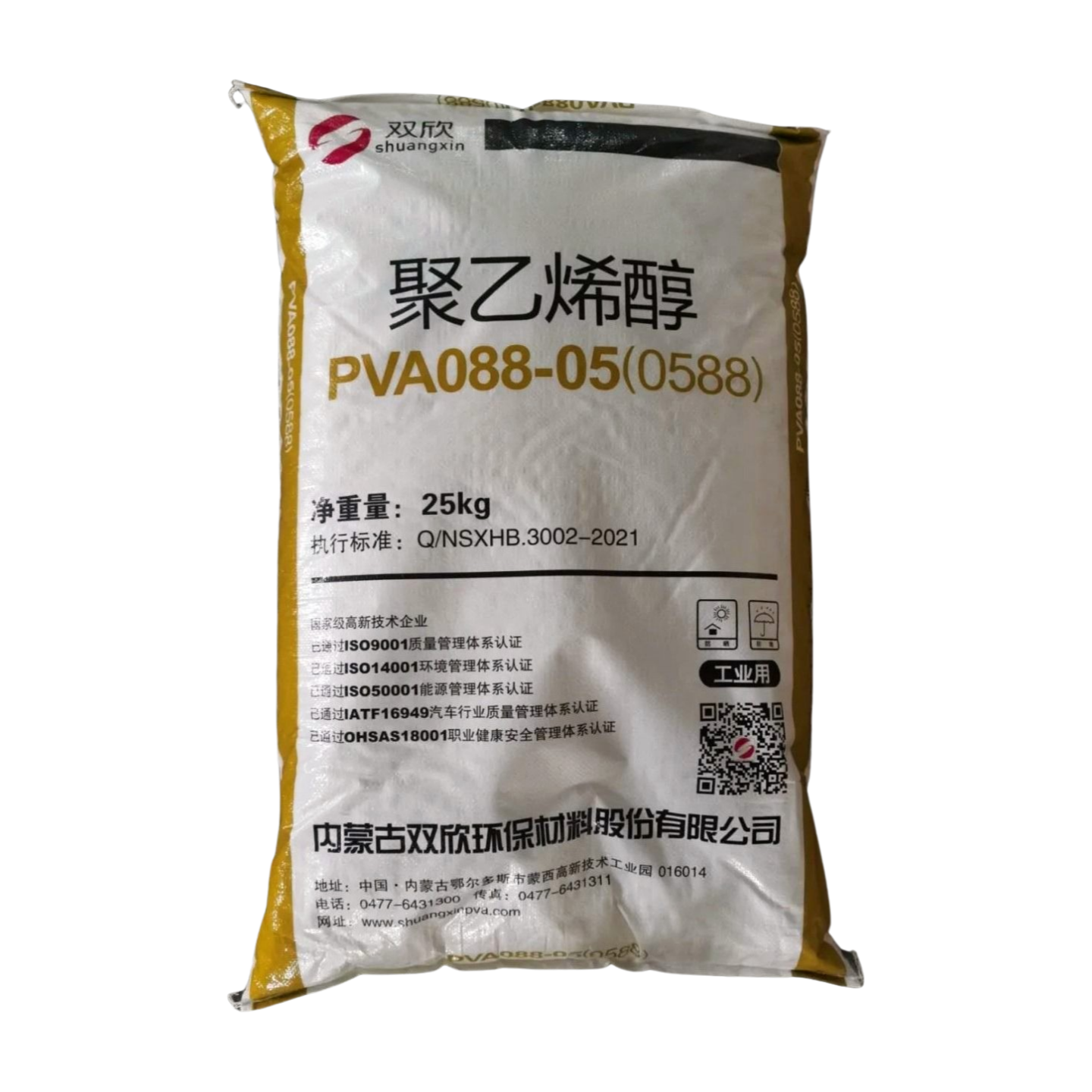
PVA 0588’s Unique Molecular Profile Enables Superior Film Formation and Fiber Adhesion
How low degree of polymerization (DP ~500) and 88% hydrolysis balance flexibility, strength, and synthetic fiber affinity
PVA 0588’s molecular architecture is purpose-built for high-speed weaving of synthetic fibers. With a degree of polymerization (DP) around 500 and 88 mol% hydrolysis, it achieves an optimal balance of flexibility, cohesive strength, and affinity for hydrophobic substrates like polyester and nylon. Its low DP yields a solution viscosity of just 5.0–6.0 mPa·s—enabling deep, uniform penetration into yarn bundles and rapid wetting of synthetic fibers. Meanwhile, the 88% hydrolysis level retains enough hydroxyl groups to form strong hydrogen bonds with fibers, while residual acetate groups impart segmental mobility that prevents film brittleness. The result is a tough, elastic sizing film that flexes with the yarn under loom tension rather than cracking. Laboratory analysis confirms this composition optimizes the amorphous/crystalline ratio, delivering a strain-at-break exceeding 200% and tensile strength above 30 MPa—key metrics for durable, high-performance sizing.
Proven adhesion advantage: 23–31% higher bond strength to polyester/nylon vs. PVA 1799 (ASTM D412)
Quantitative testing per ASTM D412 demonstrates PVA 0588’s clear adhesion advantage: lap-shear bond strength on polyester and nylon films is 23–31% higher than fully hydrolyzed PVA 1799 (DP ~1700, 99% hydrolysis). On nylon, PVA 0588 achieved a mean bond strength of 4.8 N/mm² versus 3.7 N/mm² for PVA 1799—a 30% increase; on polyester, the gain was 27%. This performance stems from molecular design—not over-rigidity. Unlike PVA 1799, whose high hydroxyl content produces a brittle film prone to cohesive failure at the interface, PVA 0588 deforms plastically under peel stress, absorbing energy and maintaining interfacial integrity. In field trials, this translated directly to fewer yarn breaks and less shedding during weaving, contributing to a 37% reduction in loom stops compared to a starch-based reference.
Enhanced Warp Yarn Performance Under High-Speed Weaving Conditions
Tensile retention: 18–22% improvement over starch systems; reduced breakage on air-jet looms (ISO 2062)
PVA 0588’s low-DP, partially hydrolyzed structure forms a film that absorbs the rapid, repetitive stress cycles of air-jet looms without fracturing. Controlled ISO 2062 testing shows yarns sized with PVA 0588 retain 18–22% more tensile strength after sizing and drying than those treated with standard starch formulations. Starch films, being inherently brittle, crack under high-frequency elongation—exposing fibers to abrasion and triggering sudden breaks. In contrast, PVA 0588’s elastic film distributes stress uniformly along the yarn, eliminating localized weak points. This superior tensile retention is the primary driver behind significantly fewer warp end breaks—enabling higher machine speeds, greater output, and improved process stability.
Field-validated reliability: 37% fewer loom stops/month across three Asian weaving mills
Real-world performance confirms the lab findings. Data from three high-volume textile mills in Asia—running air-jet looms on 100% polyester filament warps—showed a consistent 37% reduction in average monthly loom stops after switching to PVA 0588. Since each stop halts production and requires manual re-threading, this improvement delivers measurable gains in labor efficiency, uptime, and throughput—especially critical at high speeds where even minor interruptions compound rapidly. The consistency of this result across diverse operational settings underscores PVA 0588’s reliability as a high-performance sizing agent rooted in robust molecular engineering—not just theoretical advantage.
Controlled Desizability Without Sacrificing Sizing Integrity
Rapid, residue-free desizing at 60–70°C in ≤15 min (AATCC 135); zero fiber damage or gumming
PVA 0588 desizes completely in water at 60–70°C, meeting AATCC 135 requirements in ≤15 minutes—without enzymatic aids or high-energy rinsing. Its 88% hydrolysis level ensures rapid, uniform hydration and full dissolution, leaving no sticky residues or gumming on fibers. By contrast, starch-based sizes often require extended enzymatic treatment and multiple hot rinses, while higher-hydrolysis PVAs like 1799 demand near-boiling temperatures and still risk incomplete removal. Independent testing confirms zero surface damage to polyester or nylon filaments and no detectable residual film after a single wash cycle. Mills report consistently clean, undamaged fabric post-desizing—eliminating rewash needs, staining risks, and secondary scouring steps. This efficient, low-temperature process reduces water, energy, and processing time—without compromising yarn integrity or downstream quality.
Strategic Selection of PVA 0588 Over Alternatives for Synthetic Fiber Applications
Weaving mills optimizing for synthetic filaments face a clear performance trade-off among sizing agents. Starch-based systems—though economical—deliver lower tensile retention (18–22% below PVA 0588) and contribute to more frequent loom stops on high-speed air-jet looms. Fully hydrolyzed PVA grades like 1799 provide excellent film strength but suffer from poor synthetic-fiber adhesion (23–31% lower bond strength than PVA 0588, per ASTM D412) and difficult desizing. PVA 0588 resolves these conflicts: its DP ~500 and 88% hydrolysis deliver robust yet flexible films with strong synthetic-fiber affinity and rapid, residue-free removal at mild temperatures (≤15 min at 60–70°C). As validated across laboratory and mill-scale trials, this integrated performance translates to 37% fewer loom stops, higher weaving efficiency, and lower total production cost—making PVA 0588 the strategically optimal choice for consistent, high-speed synthetic fabric manufacturing.
FAQ Section
What makes PVA 0588 unique for synthetic fiber sizing?
Its low degree of polymerization (DP ~500) and 88% hydrolysis provide an optimal balance of film flexibility, adhesion strength, and ease of desizing, making it ideal for synthetic fiber applications.
How does PVA 0588 compare to other sizing agents?
PVA 0588 outperforms starch-based systems in tensile strength retention and reduces loom stops by 37%. It also delivers stronger adhesion to synthetic fibers compared to fully hydrolyzed PVAs such as PVA 1799.
What are the desizing benefits of PVA 0588?
PVA 0588 desizes completely in water at 60–70°C within 15 minutes, leaving no residues or fiber damage, unlike starch or higher-hydrolysis PVAs.
How does PVA 0588 improve weaving efficiency?
Its elastic film absorbs stress uniformly, reducing yarn breakage and increasing warp performance, leading to fewer loom stops and higher output.
Table of Contents
- PVA 0588’s Unique Molecular Profile Enables Superior Film Formation and Fiber Adhesion
- Enhanced Warp Yarn Performance Under High-Speed Weaving Conditions
- Controlled Desizability Without Sacrificing Sizing Integrity
- Strategic Selection of PVA 0588 Over Alternatives for Synthetic Fiber Applications
- FAQ Section